GATE-2012 ECE Q24 (math)

Question 24 on math from GATE (Graduate Aptitude Test in Engineering) 2012 Electronics and Communication Engineering paper.

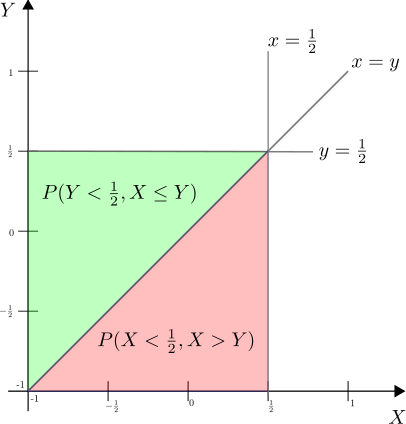
Q24. Two independent random variables X and Y are uniformly distributed in the interval [-1, 1]. The probability that max[X,Y] is less than 1/2 is

(A) 3/4

(B) 9/16

(C) 1/4

(D) 2/3
Continue reading “GATE-2012 ECE Q24 (math)”

GATE-2012 ECE Q6 (digital)

Question 6 on digital circuit from GATE (Graduate Aptitude Test in Engineering) 2012 Electronics and Communication Engineering paper.

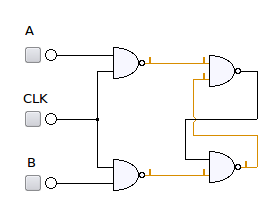
Q6. Consider the given circuit

In this circuit, the race around

(A) does not occur

(B) occurs when CLK=0

(C) occurs when CLK=1 and A=B=1

(D) occurs when CLK=1 and A=B=0

Continue reading “GATE-2012 ECE Q6 (digital)”

Modeling phase noise (frequency domain approach)

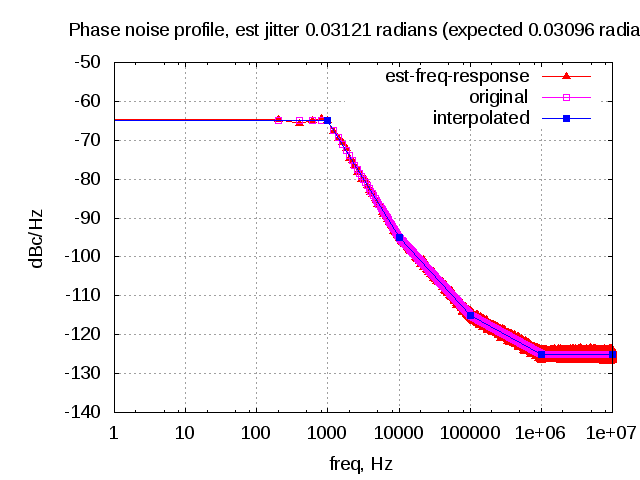
In typical wireless system simulations, there is  a need to model the phase noise profile of the local oscillator. For eg, the phase noise profile of the oscillator can be of the shape described in the post on Phase Noise Power Spectral Density to Jitter. While looking around for example Matlab code, found two references [1, 2] which uses the approach of defining the phase noise profile in frequency domain, and then using ifft() to convert to the time domain samples. This post gives a brief overview of the modeling and provides an example Matlab/Octave code.

Continue reading “Modeling phase noise (frequency domain approach)”

Migration to new template (skin)

Hi,

Those visiting the blog might have noticed a fresh look to the dspLog. This new feel is thanks to the Thesis Magazine Skin provided by FourBlogger Skins.
Click here to view more details.

There some more tinkering required at some places. But, in general most of the settings are taken care.

Hope you like the new like and feel. Please drop your feedback in the comment section.


Transmit spectrum with phase noise

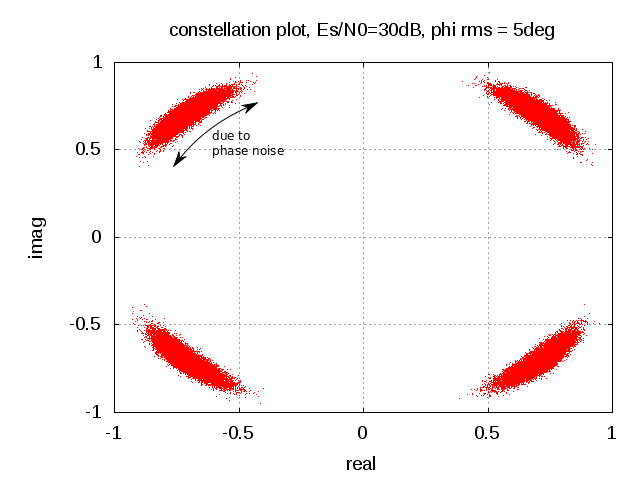
The earlier posts on phase noise discussed about phase noise in oscillators, conversion of phase noise profile to jitter and the impact of phase noise on the error vector magnitude (evm). This post discuss the impact of phase noise on the spectrum of the transmit waveform.  A simple random QPSK modulated symbols, oversampled and passed through a root raised cosine filtering is used for the simulation. Continue reading “Transmit spectrum with phase noise”

Phase noise power spectral density to Jitter

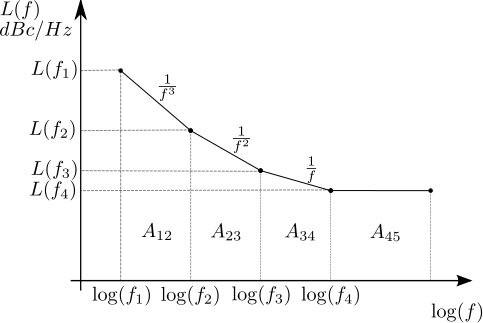
Following a brief discussion with my friend Mr. Rethnakaran Pulikkoonattu on phase noise profiles, he pointed me to his write up on Oscillator Phase Noise and Sampling Clock Jitter . In this post, we will discuss the math behind integrating the phase noise power spectral density (in dBc/Hz) to find the root mean square jitter value.

Continue reading “Phase noise power spectral density to Jitter”

Oscillator phase noise

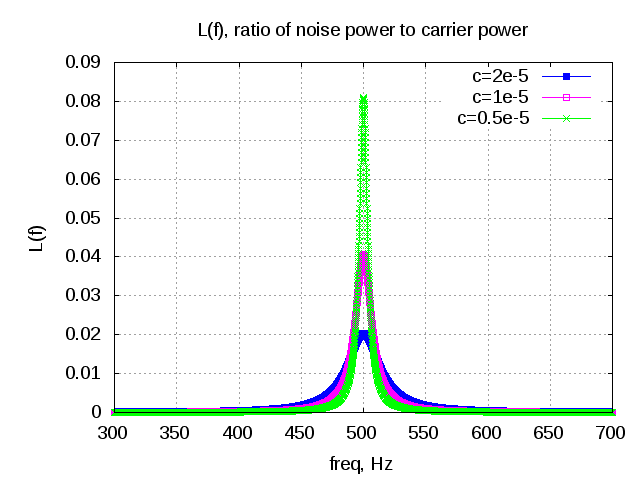
Oscillators are used in typical radio circuits to drive the mixer used for the up-conversion or down-conversion of the passband transmission. Ideally, the spectrum of the oscillator is expected to have an impulse at the frequency of oscillation with no frequency components else where. However the spectrum of practical oscillators do have spectrum skirts around the oscillation frequency caused due to phase noise. This post discuss about the phase noise of oscillator and the metrics used to specify it.

Continue reading “Oscillator phase noise”

Thermal noise of RC low pass filter


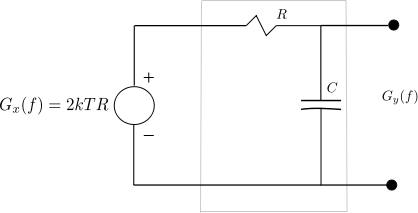
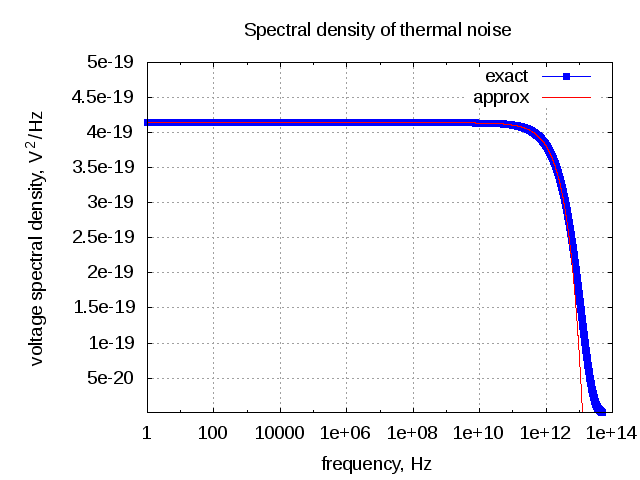
This post discuss about the thermal noise in RC low pass filter. Using the noise equivalent model using resistor with a voltage source, which gets passed through a no noise RC low pass filter. The noise power at the output is computed by integrating the output voltage spectral density over all frequencies.

Continue reading “Thermal noise of RC low pass filter”

Noise Figure of resistor network

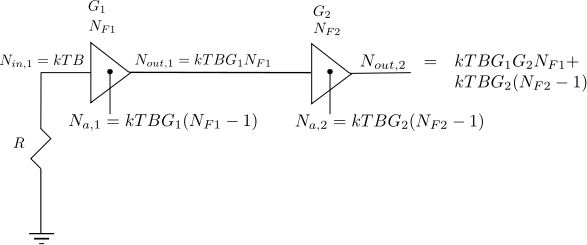
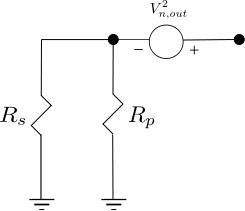
The post on thermal noise described the noise produced by resistor  ohms over bandwidth  at temperature Kelvin. In this post, let us define the noise voltage at the input and output of a resistor network and further use it to define the Noise Figure of such a network.

Continue reading “Noise Figure of resistor network”

Solved!

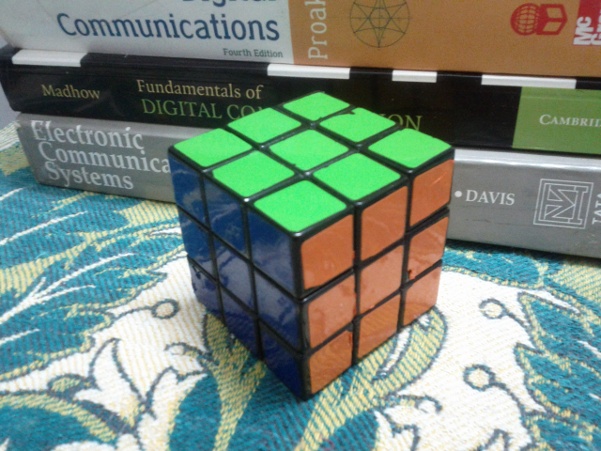
SOLVED the Rubik’s cube !!!  

After 6 months, 2 cube’s and countless twists and turns, extremely glad to reach here.

Will enjoy the beauty of the solved cube for couple of days before breaking it and going over the whole journey again….

(Thanks dear Kunju for introducing me to the cube)

Disclosure :

After solving the first two layers, going got really tough. Couple of pointers from Rubik’s original website helped me proceed.


Thermal Noise and AWGN

A friend called me up couple of days back with the question – How white is AWGN? I gave him an answer over phone, which he was not too happy about. That got me thinking bit more on the topic and the result is this post – brief write up on thermal noise and it’s modelling as Additive White Gaussian Noise aka AWGN.

Continue reading “Thermal Noise and AWGN”