Towards the last three months, the posting frequency has drastically dropped. Partly attributed to paucity of time following my change of employer and of course, laziness. 🙂
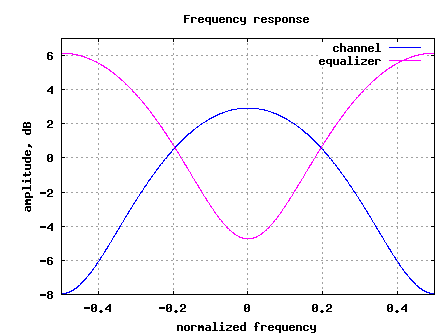
In the past, we had discussed BER for BPSK in flat fading Rayleigh channel. In this post, lets discuss a frequency selective channel with the use of Zero Forcing (ZF) equalization to compensate for the inter symbol interference (ISI). For simplifying the discussion, we will assume that there is no pulse shaping at the transmitter. The ISI channel is assumed to be a fixed 3 tap channel.
As on 21st October 2007, we moved from blogspot domain at to the self hosted domain at https://dsplog.com. Over the last two years, the blog has grown quite a bit, and am reasonably happy with the progress. Let us look back at the positives and negatives over the last year.
The IEEE 802.11a specifications are used by many to understand a wireless communication link built using OFDM. In this post, I have put together a set of 10 multiple choice questions based on 802.11a specifications. The questions are on the building blocks in 802.11a specifications, preamble structure and so on. Upon completion of the quiz, you will be lead to a page showing the correct answers and their explanations.
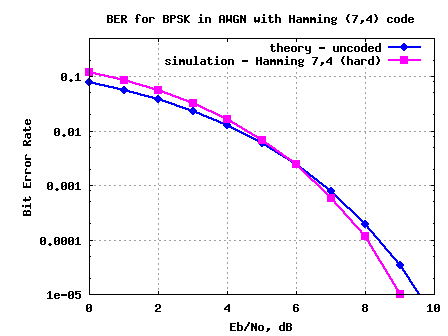
In previous posts, we have discussed convolutional codes with Viterbi decoding (hard decision, soft decision and with finite traceback). Let us know discuss a block coding scheme where a group of information bits is mapped into coded bits. Such codes are referred to as codes. We will restrict the discussion to Hamming codes, where 4 information bits are mapped into 7 coded bits. The performance with and without coding is compared using BPSK modulation in AWGN only scenario.
While browsing through the web for materials on the wireless communication and implementation, found this rich set of articles as part of MIT OPEN COURSEWARE program. The course is from Vladimir Stojanovic, course materials for 6.973 Communication System Design, Spring 2006. MIT OpenCourseWare (http://ocw.mit.edu/), Massachusetts Institute of Technology.
Are you bothered by speed of the speed of the simulations which you develop in Matlab/Octave? I was not bothered much, till I ran into the Viterbi decoder. If you recall, the Matlab/Octave simulation script for BER computation with hard soft decision Viterbi algorithm provided in post Viterbi with finite survivor state memorytook around 10 hours to run.
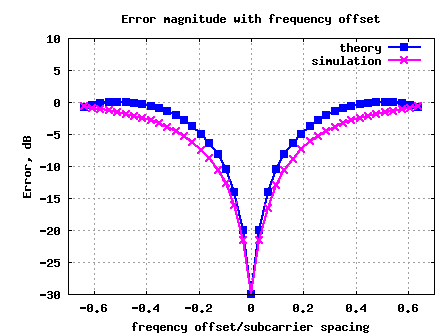
In this post, let us evaluate the impact of frequency offset resulting in Inter Carrier Interference (ICI) while receiving an OFDM modulated symbol. We will first discuss the OFDM transmission and reception, the effect of frequency offset and later we will define the loss of orthogonality and resulting signal to noise ratio (SNR) loss due to the presence of frequency offset. The analysis is accompanied by Matlab/Octave simulation scripts.
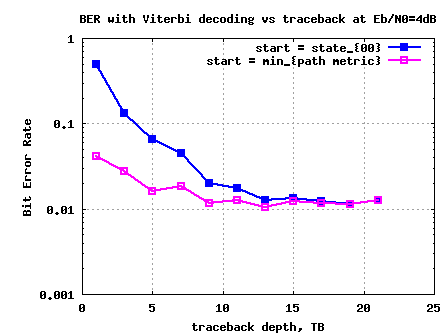
In the post on Viterbi decoder and soft input Viterbi decoder, we discussed a convolutional encoding scheme with rate 1/2, constraint length and having generator polynomial and having generator polynomial . If the number of uncoded bits is , then the number of coded bits at the output of the convolutional encoder is . Decoding the convolutionaly encoded bits by Viterbi algorithm consisted of the following steps.
In the post on Soft Input Viterbi decoder, we had discussed BPSK modulation with convolutional coding and soft input Viterbi decoding in AWGN channel. Let us know discuss the derivation of soft bits for 16QAM modulation scheme with Gray coded bit mapping. The channel is assumed to be AWGN alone.
My friend Mr. Balaji volunteers for Vibha, a non-profit organization whose mission is to ensure that every underprivileged child attains his or her right to education, health and opportunity.
Vibha, which was founded in 1991 has a volunteer network of 825 members spread across Atlanta, Austin, Bay Area, Boston, Chicago, Dallas, Houston, Jacksonville, Los Angeles, Milwaukee, Twin Cities – Minnesota, New York, Philadelphia, Sacramento, Washington DC and several other cities across the US and India. Till date, we have supported about 190 projects in India and the US. You may read more about their projects here.
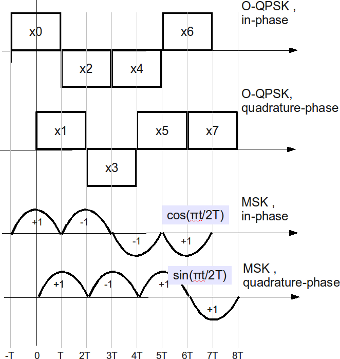
In a post on Minimum Shift Keying (MSK), we had discussed that MSK uses two frequencies which are separated by and phase discontinuity is avoided in symbol boundaries. In that post, we had discussed MSK as a continuous phase transmit signal and showed that phase changes through 0, 90, 180 and 270 degrees. In this post, we will discuss MSK transmission as a variant of offset-QPSK technique. Further, we will discuss the receiver structure and show that bit error rate with coherent demodulation of MSK (using time) is equivalent to that of BPSK modulation. The channel assumed is AWGN.
Using the services of a new author ‘RV’, we are starting a new series of articles in the blog. Typically in India, many of the competitive examinations pertaining to Engineering (GATE, IES) and rectuitment by private and public sector companies (ISRO, BSNL, BEL, BHEL) uses examination with objective questions for the first level screening. We are hoping that this Objective Question Answer series, mostly discussing topics pertaining to Electronics and Communication Engineering, will help those preparing for those examination. Kindly do give your feedback via comment and/or email. Thanks, Krishna
In the post on transmit pulse shaping filter, we had discussed pulse shaping using rectangular and sinc. In this post we will discuss about optimal receiver structure when pulse shaping is used at the transmitter. The receiver structure is also called as matched filter. For the discussion, we will assume rectangular pulse shaping, the channel is AWGN only and the modulation is BPSK.