Symbol Error rate for QAM (16, 64, 256,.., M-QAM)

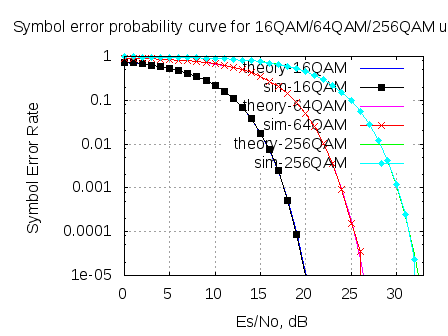
In May 2008, we derived the theoretical symbol error rate for a general M-QAM modulation (in  Embedded.comDSPDesignLine.com and dsplog.com) under Additive White Gaussian Noise. While re-reading that post, felt that the article is nice and warrants a re-run, using OFDM as the underlying physical layer. This post discuss the derivation of symbol error rate for a general M-QAM modulation. The companion Matlab script compares the theoretical and the simulated symbol error rate for 16QAM, 64QAM and 256QAM over OFDM in AWGN channel.

Enjoy and HAPPY NEW YEAR 2012 !!!

Continue reading “Symbol Error rate for QAM (16, 64, 256,.., M-QAM)”
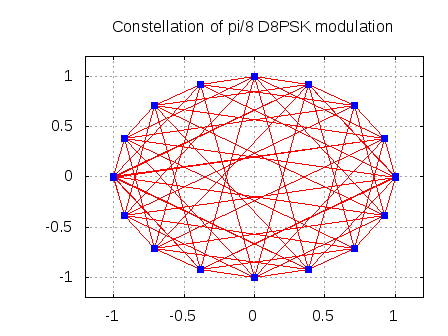
Non coherent demodulation of pi/8 D8PSK (TETRA)

In TETRA specifications, one of the modulation technique used is Differential 8 Phase Shift Keying (D8PSK). We will discuss the bit error rate with non-coherent demodulation of D8PSK in Additive White Gaussian Noise (AWGN) channel.

Continue reading “Non coherent demodulation of pi/8 D8PSK (TETRA)”

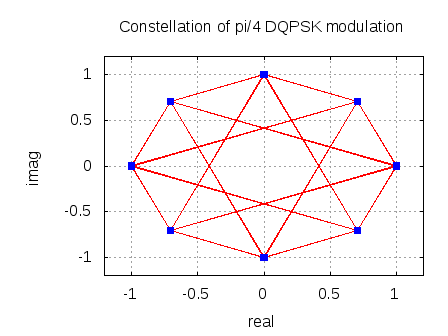
Non coherent demodulation of pi/4 DQPSK (TETRA)

In TETRA specifications, one of the modulation technique used is Differential Quaternary Phase Shift Keying (DQPSK). We will discuss the bit error rate with non-coherent demodulation of DQPSK in Additive White Gaussian Noise (AWGN) channel.

Continue reading “Non coherent demodulation of pi/4 DQPSK (TETRA)”

MSK transmitter and receiver

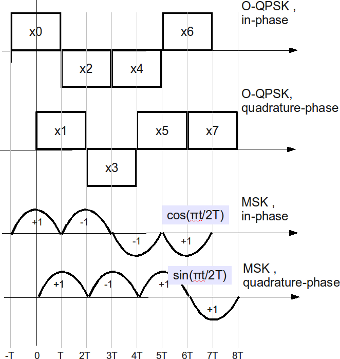
In a post on Minimum Shift Keying (MSK), we had discussed that MSK uses two frequencies which are separated by and phase discontinuity is avoided in symbol boundaries. In that post, we had discussed MSK as a continuous phase transmit signal and showed that phase changes through 0, 90, 180 and 270 degrees. In this post, we will discuss MSK transmission as a variant of offset-QPSK technique. Further, we will discuss the receiver structure and show that bit error rate with coherent demodulation of MSK (using time) is equivalent to that of BPSK modulation. The channel assumed is AWGN.

Continue reading “MSK transmitter and receiver”

Derivation of BPSK BER in Rayleigh channel

This is a guest post by Jose Antonio Urigüen who is an Electrical and Electronic Engineer currently studying an MSc in Communications and Signal Processing at Imperial College in London. This guest post has been created due to his own curiosity when reviewing some concepts of BER for BPSK in Rayleigh channnel published in the dsplog.com

From the post on BER for BPSK in Rayleigh channnel, it was shown that, in the presence of channel , the effective bit energy to noise ratio is .

Continue reading “Derivation of BPSK BER in Rayleigh channel”

Download free e-book on error probability in AWGN

We have quite a few articles discussing bit and symbol error rates for popular digital modulation schemes in Additive White Gaussian Noise (AWGN) channel. This post summarizes the articles discussing the theoretical and simulated error rates for the digital modulation schemes like BPSK, QPSK, 4PAM, 16PSK and 16QAM. Further, Bit Error Rate with Gray coded mapping, bit error rate for BPSK over OFDM are also discussed.

The links to the individual articles and the Matlab/Octave simulation models are listed below. Alternatively, I have made a e-book discussing all the below mentioned articles to a single PDF file. If you wish, you can download the free e-book by subscribing to the free email newsletter.

Subscribe and download the free e-Book

Continue reading “Download free e-book on error probability in AWGN”

BER for BPSK in Rayleigh channel

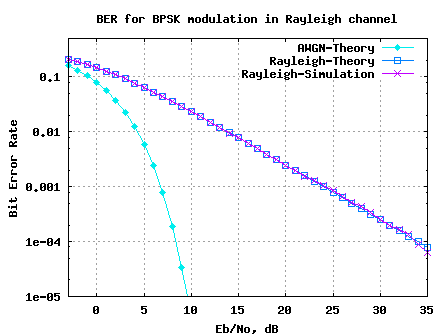
Long back in time we discussed the BER (bit error rate) for BPSK modulation in a simple AWGN channel (time stamps states August 2007). Almost an year back! It high time we discuss the BER for BPSK in a Rayleigh multipath channel.

In a brief discussion on Rayleigh channel, wherein we stated that a circularly symmetric complex Gaussian random variable is of the form,

,

where real and imaginary parts are zero mean independent and identically distributed (iid) Gaussian random variables with mean 0 and variance .

Continue reading “BER for BPSK in Rayleigh channel”

Comparing BPSK, QPSK, 4PAM, 16QAM, 16PSK, 64QAM and 32PSK

I have written another article in DSPDesginLine.com. This article can be treated as the third post in the series aimed at understanding Shannon’s capacity equation.

For the first two posts in the series are:

1. Understanding Shannon’s capacity equation

2. Bounds on Communication based on Shannon’s capacity

The article summarizes the symbol error rate derivations in AWGN for modulation schemes like BPSK, QPSK, 4PAM, 16QAM, 16PSK, 64QAM and 32PSK.

Continue reading “Comparing BPSK, QPSK, 4PAM, 16QAM, 16PSK, 64QAM and 32PSK”

16QAM Bit Error Rate (BER) with Gray mapping

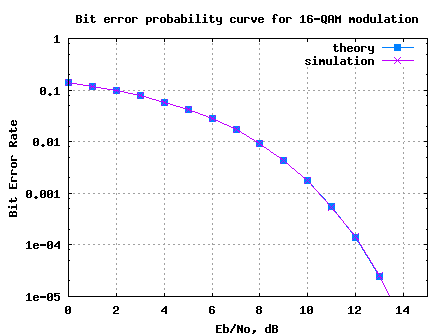
Let us derive the theoretical 16QAM bit error rate (BER) with Gray coded constellation mapping in additive white Gaussian noise conditions. Further, the Matlab/Octave simulation script can be used to confirm that the simulation is in good agreement with theory.

Continue reading “16QAM Bit Error Rate (BER) with Gray mapping”

Binary to Gray code for 16QAM

In the previous post on Binary to Gray code conversion for PSK, I had claimed that “for a general M-QAM modulation the binary to Gray code conversion is bit more complicated“. However following a closer look, I realize that this is not so complicated. 🙂

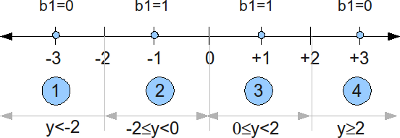
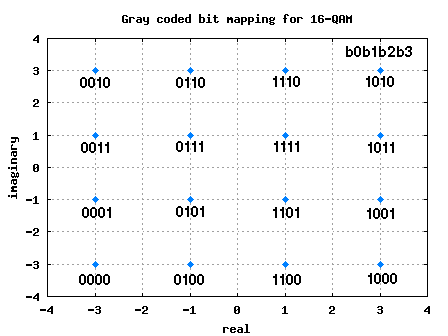
The QAM scenario can be treated as independent PAM modulation on I arm and Q-arm respectively. For example, let us consider 16-QAM scenario.

Continue reading “Binary to Gray code for 16QAM”

Article in DSPDesignLine.com: M-QAM symbol error

Its been a nice week for me, wherein I guest posted an article in DSPDesignLine.com. 🙂

The article derives the theoretical symbol error rate for M-QAM modulation. The theoretical results are further supplemented by Matlab/Octave simulation scripts.

Those who are familiar with derivation of symbol error rate for 16-QAM modulation will find the equations easy to interpret. As we did for 16-QAM,

Continue reading “Article in DSPDesignLine.com: M-QAM symbol error”

Bit error rate for 16PSK modulation using Gray mapping

In this post, let us derive the theoretical bit error probability for 16PSK modulation using Gray coded mapping. For deriving the equation, we will refer material from the following posts:

(a) Symbol Error Rate for 16PSK

(b) Gray code to Binary code conversion for PSK

(c) Binary to Gray code conversion for PSK

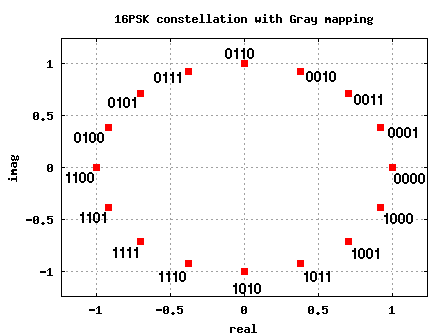
As discussed in the previous posts, the key feature of Gray code is that adjacent symbols differ by only one bit. The 16PSK constellation with Gray mapping can be as shown in the figure below.

Continue reading “Bit error rate for 16PSK modulation using Gray mapping”

Gray code to Binary conversion for PSK and PAM

Given that we have discussed Binary to Gray code conversion, let us discuss the Gray to BInary conversion.

Conversion from Gray code to natural Binary

Let be the equivalent Gray code for an bit binary number with representing the index of the bit.

1. For ,

i.e, the most significant bit (MSB) of the Gray code is same as the MSB of original binary number.

2. For ,

i.e, bit of the Binary number is the exclusive-OR (XOR) of of the bit of the Gray code and of the bit of the binary number. Continue reading “Gray code to Binary conversion for PSK and PAM”