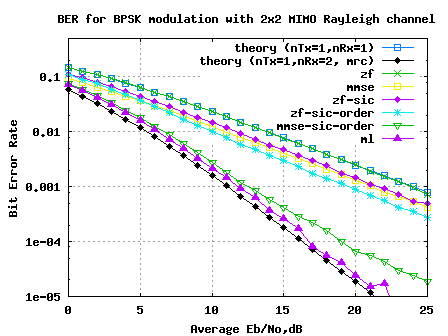
In the past, we had discussed several posts on two transmit two receive MIMO communication, where the transmission was based on V-BLAST. The details about V-BLAST can be read from the landmark paper V-BLAST: An architeture for realizing very high data rates over the rich scattering wireless channel – P. W. Wolniansky, G. J. Foschini, G. D. Golden, R. A. Valenzuela. We will assume that the channel is a flat fading Rayleigh multipath channel and the modulation is BPSK.
Year: 2009
Transmit beamforming
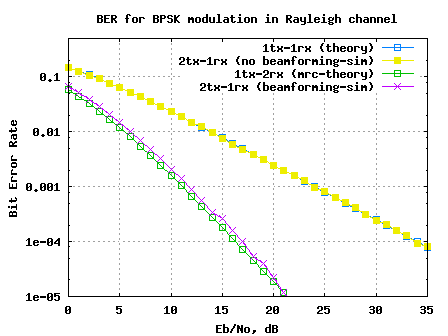
In this post lets discuss a closed-loop transmit diversity scheme, where the transmitter has the knowledge of the channel. As there is a feedback path required from the receiver, to communicate the channel seen by the receiver to the transmitter, the scheme is called closed-loop transmit diversity scheme. Recall that the transmit diversity using Space Time Coding (Alamouti STBC) does not require the knowledge of the channel. In this post, we will restrict our discussion to a 2 transmit, 1 receive case. We will assume that the channel is a flat fading Rayleigh multipath channel and the modulation is BPSK.
Milestone 1000+ subscribers 1100+ comments
Those who are regular visitors to dsplog.com might have noticed the small FeedBurner chicklet on the side showing subscriber count showing 1000+ subscribers. Its a nice milestone to reach, one that looked so distant when I wrote the first post stating the objective of this blog on 26th February 2007. We now have around 86 articles with 1100+ comments.


Brief History
- First post : Objective February 26th 2007
- Migration from Blogger to to self hosted domain @ dsplog.com : October 2007
- Migration to Deep Blue theme : May 4th 2008
- Availability of free e-Book on Error Rates in AWGN : October 1st 2008
- Migration to Who’s Who theme : January 13th 2009
Subscribe
The rate of new subscribers improved dramatically once I introduced the free e-Book in October of 2008.
Joining the email subscription list entitles you to receive the free e-Book on Probability of Error for BPSK/QPSK/16QAM/16PSK/64QAM in AWGN.
Subscribe and download the free e-Book
Alternatively, you may subscribe to the RSS feed by clicking here.
Future
While writing the posts, making the simulations to work and responding to all those comments, I learned a lot over the last two years. The signalprocessing for wireless comunication is a vast area and we have only just briefly started. I hope to continue to discuss topic relavent to signal processing for comuniction.
I am hoping that reaching the next 1000 subscribers wont take another two years, and for achieveing that I need your help. If each of you can tell atleast five of your friends/colleagues about this blog, it will go a long way in spreading the word about the blog. Thanks in advance.
Other thoughts
Over the past 6 to 8 weeks, I know that am guilty of not keeping up with the one past per week target which I have set myself nor am able to respond to comments within 2-3 days. I am not able to squeeze sufficient time for blogging after office work and parenting. I hope to come back to one post per week cycle from the second week of April 2009.
Alamouti STBC with 2 receive antenna
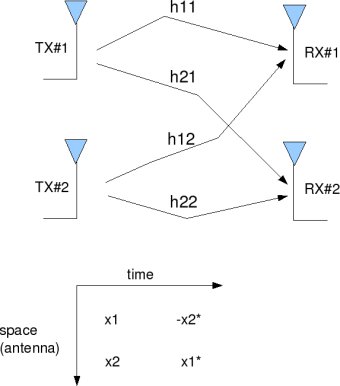
In the past, we had discussed two transmit, one receive antenna Alamouti Space Time Block Coding (STBC) scheme. In this post, lets us discuss the impact of having two antennas at the receiver. For the discussion, we will assume that the channel is a flat fading Rayleigh multipath channel and the modulation is BPSK.
Continue reading “Alamouti STBC with 2 receive antenna”
IQ imbalance in transmitter
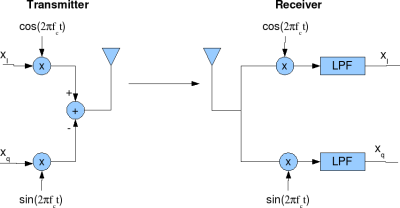
Typical communication systems use I-Q modulation and we had discussed the need for I-Q modulation in the past. In this post, let us understand I-Q imbalance and its effect on transmit signal.
Approximate Vector Magnitude Computation
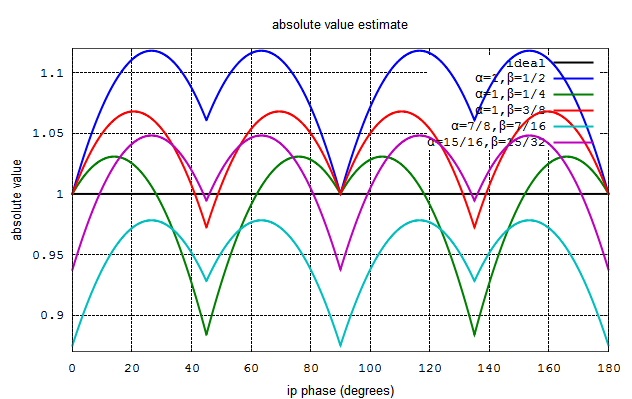
In this post, let us discuss a simple implementation friendly scheme for computing the absolute value of a complex number . The technique called
(alpha Max + beta Min) algorithm is discussed in Chapter 13.2 of Understanding Digital Signal Processing, Richard Lyons

The magnitude of a complex number is
.
The simplified computation of the absolute value is
where
.
Derivation of BPSK BER in Rayleigh channel
This is a guest post by Jose Antonio Urigüen who is an Electrical and Electronic Engineer currently studying an MSc in Communications and Signal Processing at Imperial College in London. This guest post has been created due to his own curiosity when reviewing some concepts of BER for BPSK in Rayleigh channnel published in the dsplog.com
From the post on BER for BPSK in Rayleigh channnel, it was shown that, in the presence of channel , the effective bit energy to noise ratio is
.
Continue reading “Derivation of BPSK BER in Rayleigh channel”
Soft Input Viterbi decoder
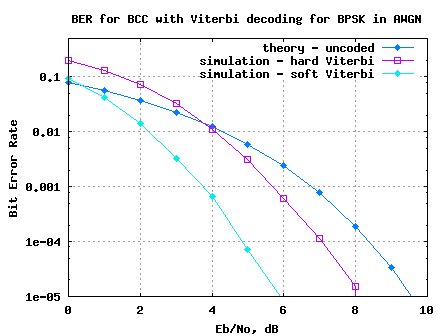
In two previous posts, we have discussed Convolutional Coding and the associated hard decision Viterbi decoding. In this post lets extent Viterbi decoding algorithm to soft input decision scheme. The modulation used is BPSK and the channel is assumed to be AWGN alone.
Migration to Who’s Who theme
After a gap of around 7 months, we decided to migrate to a new template (recall, last time we changed was in May 2008). The template which we decided to use is designed by Elegant Themes. They have a wide array of themes and I chose to use the Who’s Who theme.
Viterbi decoder
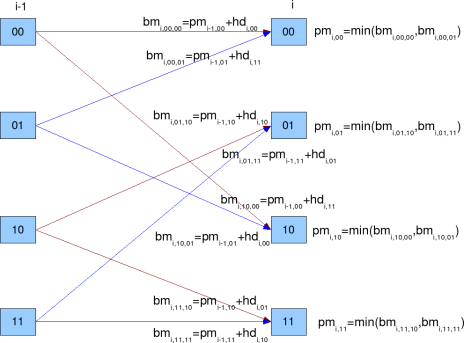
Coding is a technique where redundancy is added to original bit sequence to increase the reliability of the communication. Lets discuss a simple binary convolutional coding scheme at the transmitter and the associated Viterbi (maximum likelihood) decoding scheme at the receiver.
Update: For some reason, the blog is unable to display the article which discuss both Convolutional coding and Viterbi decoding. As a work around, the article was broken upto into two posts.
This post descrbes the Viterbi decoding algorithm for a simple Binary Convolutional Code with rate 1/2, constraint length and having generator polynomial
. For more details on the Binary convolutional code, please refer to the post – Convolutional code
Convolutional code
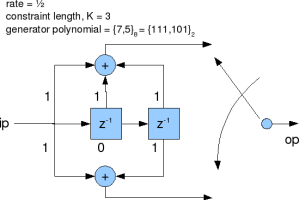
Coding is a technique where redundancy is added to original bit sequence to increase the reliability of the communication. In this article, lets discuss a simple binary convolutional coding scheme at the transmitter and the associated Viterbi (maximum likelihood) decoding scheme at the receiver.
Update: For some reason, the blog is unable to display the article which discuss both Convolutional coding and Viterbi decoding. As a work around, the article was broken upto into two posts. This post descrbes a simple Binary Convolutional Coding scheme. For details on the Viterbi decoding algorithm, please refer to the post – Viterbi decoder.
Chapter 8, Table 8.2-1 of Digital Communications by John Proakis lists the various rate 1/2 convolutional coding schemes. The simplest among them has constraint length with generator polynomial
. There are three parameters which define the convolotional code: