Summary – feedback on [dspLog], July 2008

On July30th, 2008 I had sent a request for feedback to 93 subscribers who have opted to receive articles over email. As on 3rd August, I received the response from around 8 persons. Not bad, around 8.5% response. Thanks a lot for the feedback. I will summarize the response from the group and note down … Continue reading “Summary – feedback on [dspLog], July 2008”
Gradients for multi class classification with Softmax

In a multi class classification problem, the output (also called the label or class) takes a finite set of discrete values . In this post, system model for a multi class classification with a linear layer followed by softmax layer is defined. The softmax function transforms the output of a linear layer into values lying … Continue reading “Gradients for multi class classification with Softmax”

Gradients for Binary Classification with Sigmoid

In a classification problem, the output (also called the label or class) takes a small number of discrete values rather than continuous values. For a simple binary classification problem, where output takes only two discrete values : 0 or 1, the sigmoid function can be used to transform the output of a linear regression model … Continue reading “Gradients for Binary Classification with Sigmoid”

Gradients for linear regression

Understanding gradients is essential in machine learning, as they indicate the direction and rate of change in the loss function with respect to model parameters. This post covers the gradients for the vanilla Linear Regression case taking two loss functions Mean Square Error (MSE) and Mean Absolute Error (MAE) as examples. The gradients computed analytically … Continue reading “Gradients for linear regression”

Migration to new template (skin)

Hi, Those visiting the blog might have noticed a fresh look to the dspLog. This new feel is thanks to the Thesis Magazine Skin provided by FourBlogger Skins. Click here to view more details. There some more tinkering required at some places. But, in general most of the settings are taken care. Hope you like … Continue reading “Migration to new template (skin)”

Oscillator phase noise

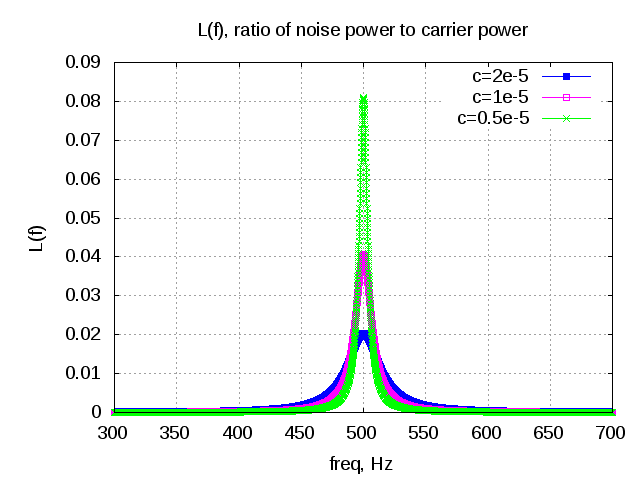
Oscillators are used in typical radio circuits to drive the mixer used for the up-conversion or down-conversion of the passband transmission. Ideally, the spectrum of the oscillator is expected to have an impulse at the frequency of oscillation with no frequency components else where. However the spectrum of practical oscillators do have spectrum skirts around … Continue reading “Oscillator phase noise”

Matlab or C for Viterbi Decoder?

Are you bothered by speed of the speed of the simulations which you develop in Matlab/Octave? I was not bothered much, till I ran into the Viterbi decoder. If you recall, the Matlab/Octave simulation script for BER computation with hard soft decision Viterbi algorithm provided in post Viterbi with finite survivor state memory took around … Continue reading “Matlab or C for Viterbi Decoder?”

Solved objective questions (GATE)

Using the services of a new author ‘RV’, we are starting a new series of articles in the blog. Typically in India, many of the competitive examinations pertaining to Engineering (GATE, IES) and rectuitment by private and public sector companies (ISRO, BSNL, BEL, BHEL) uses examination with objective questions for the first level screening. We … Continue reading “Solved objective questions (GATE)”

Transmit beamforming

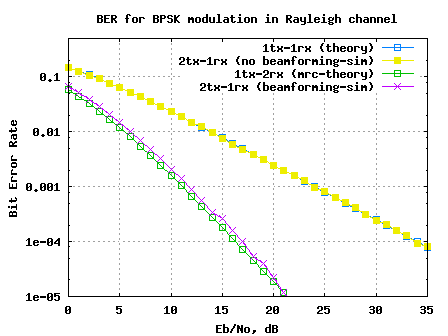
In this post lets discuss a closed-loop transmit diversity scheme, where the transmitter has the knowledge of the channel. As there is a feedback path required from the receiver, to communicate the channel seen by the receiver to the transmitter, the scheme is called closed-loop transmit diversity scheme. Recall that the transmit diversity using Space … Continue reading “Transmit beamforming”

Milestone 1000+ subscribers 1100+ comments

Those who are regular visitors to dsplog.com might have noticed the small FeedBurner chicklet on the side showing subscriber count showing 1000+ subscribers. Its a nice milestone to reach, one that looked so distant when I wrote the first post stating the objective of this blog on 26th February 2007. We now have around 86 … Continue reading “Milestone 1000+ subscribers 1100+ comments”

Download free e-book on error probability in AWGN

We have quite a few articles discussing bit and symbol error rates for popular digital modulation schemes in Additive White Gaussian Noise (AWGN) channel. This post summarizes the articles discussing the theoretical and simulated error rates for the digital modulation schemes like BPSK, QPSK, 4–PAM, 16PSK and 16QAM. Further, Bit Error Rate with Gray coded … Continue reading “Download free e-book on error probability in AWGN”

Update: Correction in Matlab code for raised cosine filter

Thanks to the keen observation by Mr. Phan Minh Hoang, I was notified that the Matlab/Octave scripts provided along with the topic raised cosine filtering was not behaving properly. Reason: I was not taking care of the division by zero when creating the raised cosine filter taps. 🙁