BER for BPSK in ISI channel with Zero Forcing equalization

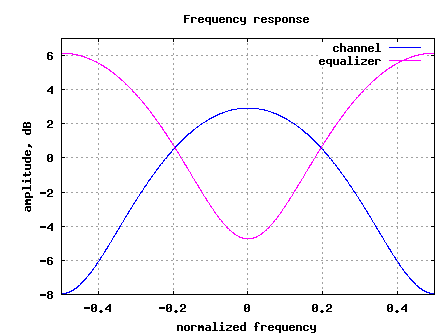
In the past, we had discussed BER for BPSK in flat fading Rayleigh channel. In this post, lets discuss a frequency selective channel with the use of Zero Forcing (ZF) equalization to compensate for the inter symbol interference (ISI). For simplifying the discussion, we will assume that there is no pulse shaping at the transmitter. The ISI channel is assumed to be a fixed 3 tap channel.

Continue reading “BER for BPSK in ISI channel with Zero Forcing equalization”
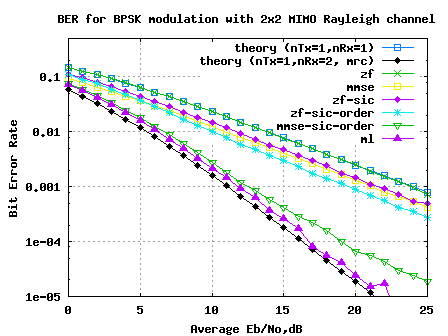
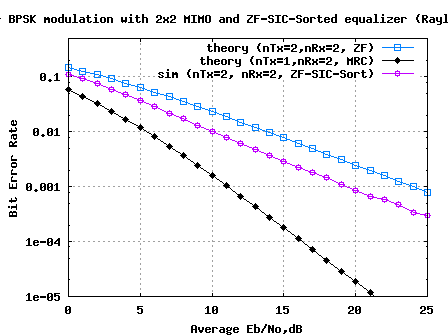
Six equalizers for V-BLAST

In the past, we had discussed several posts on two transmit two receive MIMO communication, where the transmission was based on V-BLAST. The details about V-BLAST can be read from the landmark paper V-BLAST: An architeture for realizing very high data rates over the rich scattering wireless channel – P. W. Wolniansky, G. J. Foschini, G. D. Golden, R. A. Valenzuela. We will assume that the channel is a flat fading Rayleigh multipath channel and the modulation is BPSK.

Continue reading “Six equalizers for V-BLAST”

MIMO with ZF SIC and optimal ordering

In previous posts, we had discussed equalization of a 2×2 MIMO channel with Zero Forcing (ZF) equalization and later, Zero Forcing equalization with successive interference cancellation (ZF-SIC). In this post, we will explore a variant of ZF-SIC called Zero Forcing Successive Interference Cancellation with optimal ordering. We will assume that the channel is a flat fading Rayleigh multipath channel and the modulation is BPSK.

Continue reading “MIMO with ZF SIC and optimal ordering”

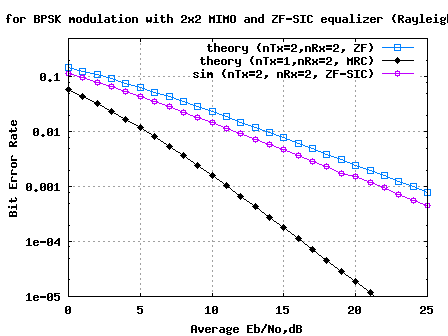
MIMO with Zero Forcing Successive Interference Cancellation equalizer

The post on MIMO with Zero Forcing equalizer discussed a probable way of equalizing a 2×2 MIMO channel. The simulated results with the 2×2 MIMO system with zero forcing equalizer showed matching results as obtained in for a 1×1 system for BPSK modulation in Rayleigh channel. In this post, we will try to improve the bit error rate performance by trying out Successive Interference Cancellation (SIC). We will assume that the channel is a flat fading Rayleigh multipath channel and the modulation is BPSK.

Continue reading “MIMO with Zero Forcing Successive Interference Cancellation equalizer”

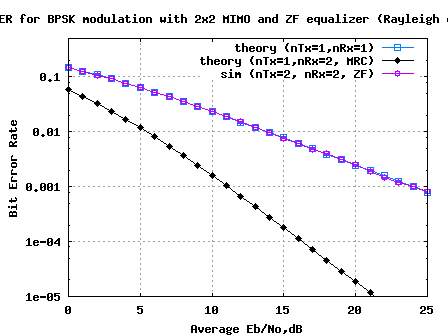
MIMO with Zero Forcing equalizer

We had discussed three Single Input Multiple Output (SIMO also known as receive diversity) schemes – Selection combining, Equal Gain Combining, Maximal Ratio Combining and a Multiple Input Single Output (MISO, also known as transmit diversity) scheme – Alamouti 2×1 STBC. Let us now discuss the case where there a multiple transmit antennas and multiple receive antennas resulting in the formation of a Multiple Input Multiple Output (MIMO) channel. In this post, we will restrict our discussion to a 2 transmit 2 receive antenna case (resulting in a 2×2 MIMO channel). We will assume that the channel is a flat fading Rayleigh multipath channel and the modulation is BPSK.

Continue reading “MIMO with Zero Forcing equalizer”