Summary – feedback on [dspLog], July 2008

On July30th, 2008 I had sent a request for feedback to 93 subscribers who have opted to receive articles over email. As on 3rd August, I received the response from around 8 persons. Not bad, around 8.5% response. Thanks a lot for the feedback. I will summarize the response from the group and note down the action items on me.

Best in [dspLog]

The majority of the people (6) found the theoretical description to be the most useful and around 3 people found the Matlab/Octave code to be the most useful. A comment came from Mr. Eddie Maalouf who suggested that we should start encourage user participation where other engineers can help to solve technical problems etc.

Continue reading “Summary – feedback on [dspLog], July 2008”
OT: Happy Schools Blog

Mr. Raghuram contacted me and informed about Happy Schools Blog.

He writes about Graduate School Admission in U.S., Job opportunities for students, University Selection based on his personal experience.

He recently published few articles which might of interest to some of our readers. Here are the URL for few articles:

Continue reading “OT: Happy Schools Blog”

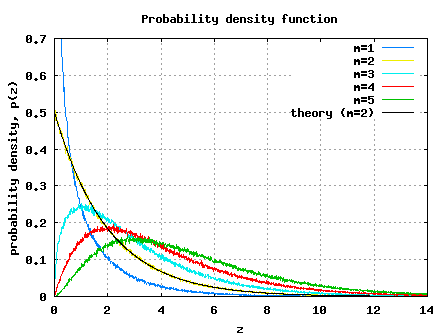
Chi Square Random Variable

While trying to derive the theoretical bit error rate (BER) for BPSK modulation in a Rayleigh fading channel, I realized that I need to discuss chi square random variable prior.

What is chi-square random variable?

Let there be independent and identically distributed Gaussian random variables with mean 0 and variance and we form a new random variable,

.

Then is a chi square random variable with degrees of freedom.

Continue reading “Chi Square Random Variable”

ICCBN 2008, July 17-20 2008, IISc, Bangalore

Advanced Computing and Communication Society (ACS) of India is organizing ICCBN 2008 conference (International Conference on Communication, Convergence, and Broadband Networking) from July 17th to 20th 2008 at National Science Seminar Complex at Indian Institute of Science (IISc), Bangalore.

ICCBN Conference aims to provide a premier forum for researchers, industry practitioners and educators to present and discuss the most recent ideas, innovations, trends, experiences, and concerns in the emerging areas of Communication, Convergence, and Broadband Networking.

Continue reading “ICCBN 2008, July 17-20 2008, IISc, Bangalore”

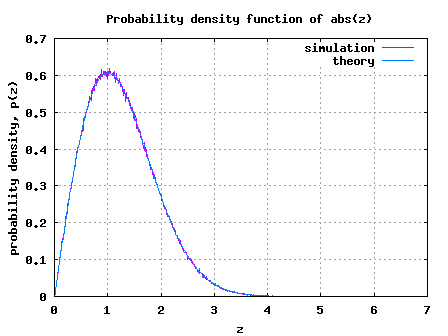
Deriving PDF of Rayleigh random variable

In the post on Rayleigh channel model, we stated that a circularly symmetric random variable is of the form , where real and imaginary parts are zero mean independent and identically distributed (iid) Gaussian random variables. The magnitude which has the probability density,

is called a Rayleigh random variable. Further, the phase is uniformly distributed from . In this post we will try to derive the expression for probability density function (PDF) for and .

Continue reading “Deriving PDF of Rayleigh random variable”

Rayleigh multipath channel model

The article gives a quick overview of a simple statistical multipath channel model called Rayleigh fading channel model.

Multipath environment

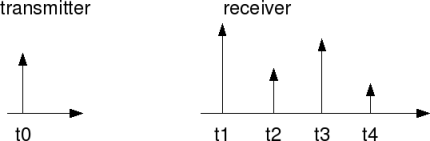
In a multipath environment, it is reasonably intuitive to visualize that an impulse transmitted from transmitter will reach the receiver as a train of impulses.

Continue reading “Rayleigh multipath channel model”

Comparing BPSK, QPSK, 4PAM, 16QAM, 16PSK, 64QAM and 32PSK

I have written another article in DSPDesginLine.com. This article can be treated as the third post in the series aimed at understanding Shannon’s capacity equation.

For the first two posts in the series are:

1. Understanding Shannon’s capacity equation

2. Bounds on Communication based on Shannon’s capacity

The article summarizes the symbol error rate derivations in AWGN for modulation schemes like BPSK, QPSK, 4PAM, 16QAM, 16PSK, 64QAM and 32PSK.

Continue reading “Comparing BPSK, QPSK, 4PAM, 16QAM, 16PSK, 64QAM and 32PSK”

Trying out PAPR reduction for OFDM by multiplication with j

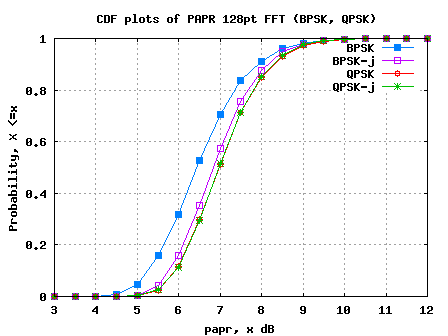
In this post, we will explore a probable way of reducing PAPR (peak to average power ratio) in OFDM by changing the phase of some of the subcarriers. This is in response to the comment to post on Peak to Average power ratio for OFDM, where Mr. Elibom suggested to reduce the PAPR by cyclically rotate some of the subcarriers and using.

Further, the presentation in the IEEE TGN, PAPR in HT-LTF (11-06/1595r1), mentions that in 40MHz mode where a 128pt FFT is used, PAPR of HT-LTF (High Throughput Long Training Field) can be reduced by multiplying the upper 20MHz subcarriers by j. Using quick Matlab simulations, we will try to validate that claim for HT-LTF and further check the PAPR for a general random BPSK and QPSK modulation.

Continue reading “Trying out PAPR reduction for OFDM by multiplication with j”

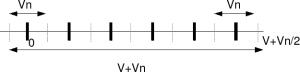
Bounds on Communication based on Shannon’s capacity

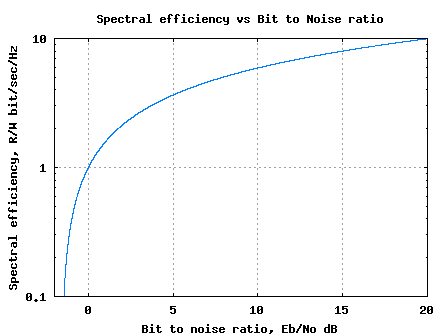
This is the second post in the series aimed at developing a better understanding of Shannon’s capacity equation. In this post let us discuss the bounds on communication given the signal power and bandwidth constraint. Further, the following writeup is based on Section 12.6 from Fundamentals of Communication Systems by John G. Proakis, Masoud Salehi

Continue reading “Bounds on Communication based on Shannon’s capacity”

Understanding Shannon’s capacity equation

Let us try to understand the formula for Channel Capacity with an Average Power Limitation, described in Section 25 of the landmark paper A Mathematical Theory for Communication, by Mr. Claude Shannon.

Further, the following writeup is based on Section 12.5.1 from Fundamentals of Communication Systems by John G. Proakis, Masoud Salehi

Continue reading “Understanding Shannon’s capacity equation”

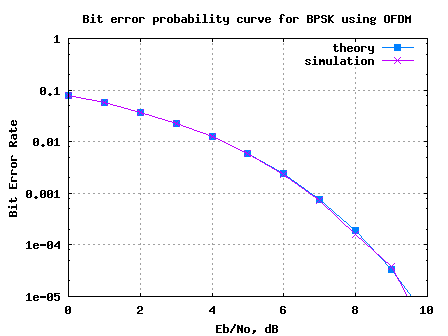
BPSK BER with OFDM modulation

Oflate, I am getting frequent requests for bit error rate simulations using OFDM (Orthogonal Frequency Division Multiplexing) modulation. In this post, we will discuss a simple OFDM transmitter and receiver, find the relation between Eb/No (Bit to Noise ratio) and Es/No (Signal to Noise ratio) and compute the bit error rate with BPSK.

Continue reading “BPSK BER with OFDM modulation”

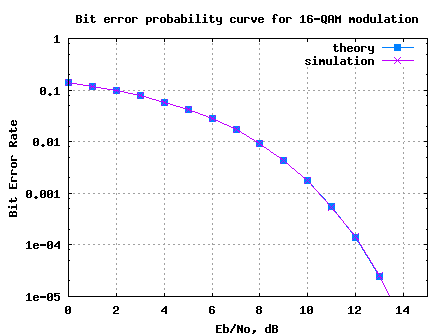
16QAM Bit Error Rate (BER) with Gray mapping

Let us derive the theoretical 16QAM bit error rate (BER) with Gray coded constellation mapping in additive white Gaussian noise conditions. Further, the Matlab/Octave simulation script can be used to confirm that the simulation is in good agreement with theory.

Continue reading “16QAM Bit Error Rate (BER) with Gray mapping”

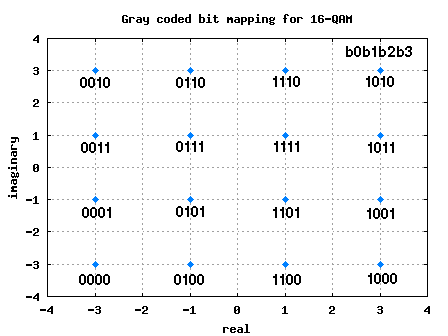
Binary to Gray code for 16QAM

In the previous post on Binary to Gray code conversion for PSK, I had claimed that “for a general M-QAM modulation the binary to Gray code conversion is bit more complicated“. However following a closer look, I realize that this is not so complicated. 🙂

The QAM scenario can be treated as independent PAM modulation on I arm and Q-arm respectively. For example, let us consider 16-QAM scenario.

Continue reading “Binary to Gray code for 16QAM”

Update: Correction in Matlab code for raised cosine filter

Thanks to the keen observation by Mr. Phan Minh Hoang, I was notified that the Matlab/Octave scripts provided along with the topic raised cosine filtering was not behaving properly.

Reason: I was not taking care of the division by zero when creating the raised cosine filter taps. 🙁 Continue reading “Update: Correction in Matlab code for raised cosine filter”