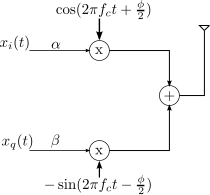
The post on IQ imbalance in transmitter, briefly discussed the effect of amplitude and phase imbalance and also showed that IQ imbalance results in spectrum at the image frequency. In this article, we will quantify the power of the image with respect to the desired tone (also known as IMage Rejection Ratio IMRR) for different values of gain and phase imbalance.
Continue reading “Image Rejection Ratio (IMRR) with transmit IQ gain/phase imbalance”Month: January 2013
GATE-2012 ECE Q15 (communication)
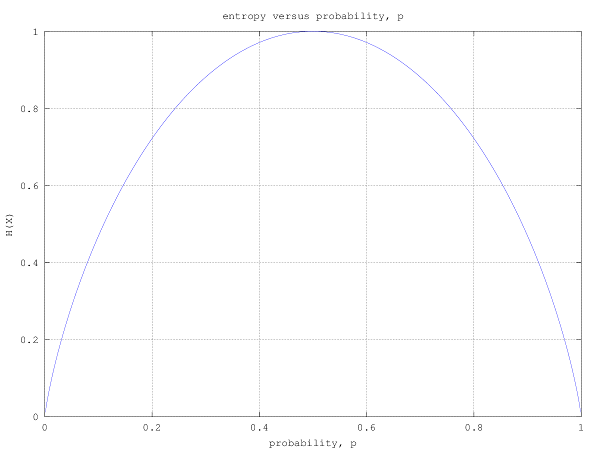
Question 15 on communication from GATE (Graduate Aptitude Test in Engineering) 2012 Electronics and Communication Engineering paper.
Q15. A source alphabet consists of N symbols with the probability of the first two symbols being the same. A source encoder increases the probability of the first symbol by a small amount  and decreases that of the second by . After encoding, the entropy of the source
(A) increases
(B) remains the same
(C) increases only if N=2
(D) decreases

GATE-2012 ECE Q7 (digital)
Question 7 on digital from GATE (Graduate Aptitude Test in Engineering) 2012 Electronics and Communication Engineering paper.
Q7. The output Y of a 2-bit comparator is logic 1 whenever the 2 bit input A is greater than 2 bit input B. The number of combinations for which output is logic 1 is
(A) 4
(B) 6
(C) 8
(D) 10
GATE-2012 ECE Q13 (circuits)
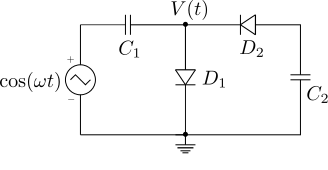
Question 13 on analog electronics from GATE (Graduate Aptitude Test in Engineering) 2012 Electronics and Communication Engineering paper.
Q13. The diodes and the capacitors in the circuit shown are ideal. The voltage }) across the diode
across the diode  is
is
(A) -1})
(B) })
(C) })
(D) })