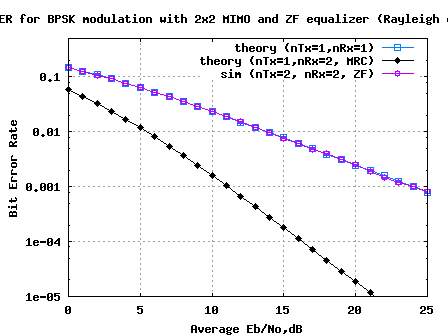
We had discussed three Single Input Multiple Output (SIMO also known as receive diversity) schemes – Selection combining, Equal Gain Combining, Maximal Ratio Combining and a Multiple Input Single Output (MISO, also known as transmit diversity) scheme – Alamouti 2×1 STBC. Let us now discuss the case where there a multiple transmit antennas and multiple receive antennas resulting in the formation of a Multiple Input Multiple Output (MIMO) channel. In this post, we will restrict our discussion to a 2 transmit 2 receive antenna case (resulting in a 2×2 MIMO channel). We will assume that the channel is a flat fading Rayleigh multipath channel and the modulation is BPSK.
Tag: BPSK
Alamouti STBC
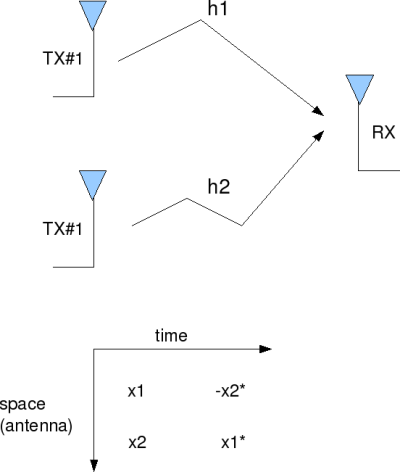
In the recent past, we have discussed three receive diversity schemes – Selection combining, Equal Gain Combining and Maximal Ratio Combining. All the three approaches used the antenna array at the receiver to improve the demodulation performance, albeit with different levels of complexity. Time to move on to a transmit diversity scheme where the information is spread across multiple antennas at the transmitter. In this post, lets discuss a popular transmit diversity scheme called Alamouti Space Time Block Coding (STBC). For the discussion, we will assume that the channel is a flat fading Rayleigh multipath channel and the modulation is BPSK.
Maximal Ratio Combining (MRC)
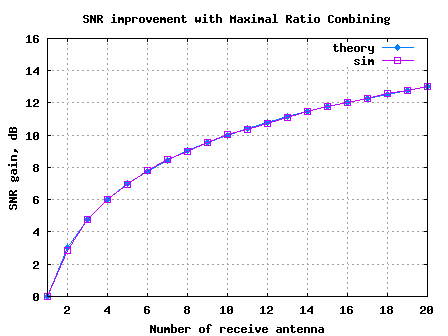
This is the third post in the series discussing receiver diversity in a wireless link. Receiver diversity is a form of space diversity, where there are multiple antennas at the receiver. The presence of receiver diversity poses an interesting problem – how do we use ‘effectively‘ the information from all the antennas to demodulate the data. In the previous posts, we discussed selection diversity and equal gain combining (EGC).
In this post, we will discuss Maximal Ratio Combining (MRC). For the discussion, we will assume that the channel is a flat fading Rayleigh multipath channel and the modulation is BPSK.
Continue reading “Maximal Ratio Combining (MRC)”
Equal Gain Combining (EGC)
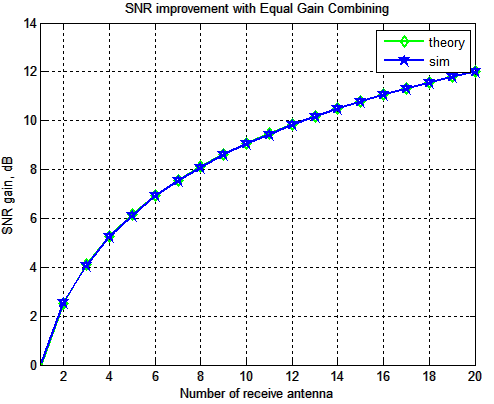
This is the second post in the series discussing receiver diversity in a wireless link. Receiver diversity is a form of space diversity, where there are multiple antennas at the receiver. The presence of receiver diversity poses an interesting problem – how do we use ‘effectively‘ the information from all the antennas to demodulate the data. In the previous post, we discussed selection diversity. In this post, we will discuss equal gain combining (EGC). For the discussion, we will assume that the channel is a flat fading Rayleigh multipath channel and the modulation is BPSK.
Selection Diversity
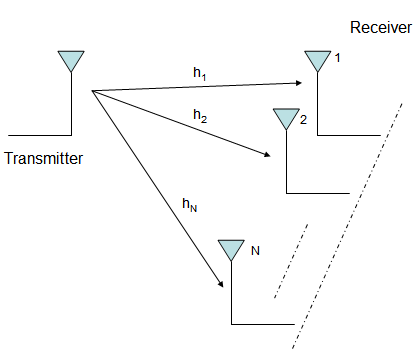
This is the first post in the series discussing receiver diversity in a wireless link. Receiver diversity is a form of space diversity, where there are multiple antennas at the receiver. The presence of receiver diversity poses an interesting problem – how do we use ‘effectively‘ the information from all the antennas to demodulate the data. There are multiple ways to approach the problem. The three typical approaches to be discussed are – selection diversity, equal gain combining and maximal ratio combining. In this post we will discuss selection diversity. For the discussion, we will assume that the channel is a flat fading Rayleigh multipath channel and the modulation is BPSK.
BER for BPSK in OFDM with Rayleigh multipath channel
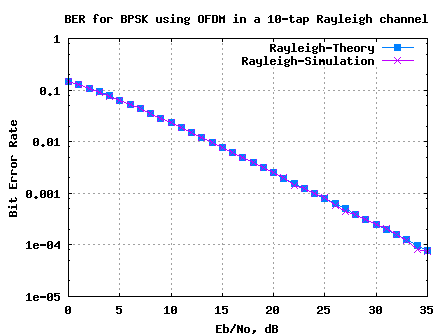
Mr. Lealem Tamirat, in a comment on BER for BPSK in Rayleigh channel, wondered about the performance of an OFDM modulated system in a frequency selective Rayeligh fading channel. My response was that,
Though the total channel is a frequency selective channel, the channel experienced by each subcarrier in an OFDM system is a flat fading channel with each subcarrier experiencing independent Rayleigh fading.
So, assuming that the number of taps in the channel is lower than the cyclic prefix duration (which ensures that there is no inter symbol interference), the BER for BPSK with OFDM in a Rayleigh fading channel should be same as the result obtained for BER for BPSK in Rayleigh fading channel.
Let us try to define a quick simulation to confirm the claim.
Continue reading “BER for BPSK in OFDM with Rayleigh multipath channel”
Receive diversity in AWGN
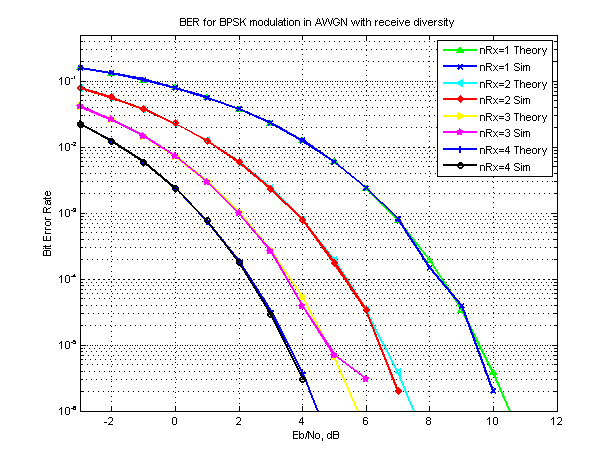
Some among you will be aware that in a wireless link having multiple antenna’s at the receiver (aka receive diversity) improves the bit error rate (BER) performance. In this post, let us try to understand the BER improvement with receive diversity. And, since we are just getting started, let us limit ourselves to additive white Gaussian noise (AWGN) channel (i.e assume that the channel gains are unity).
BPSK BER with OFDM modulation
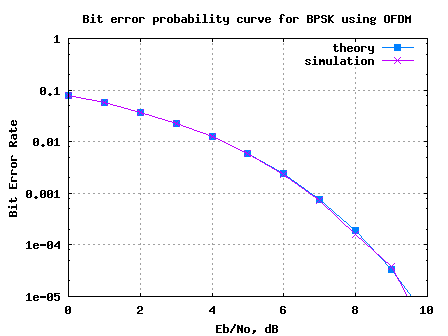
Oflate, I am getting frequent requests for bit error rate simulations using OFDM (Orthogonal Frequency Division Multiplexing) modulation. In this post, we will discuss a simple OFDM transmitter and receiver, find the relation between Eb/No (Bit to Noise ratio) and Es/No (Signal to Noise ratio) and compute the bit error rate with BPSK.
Bit Error Rate (BER) for BPSK modulation
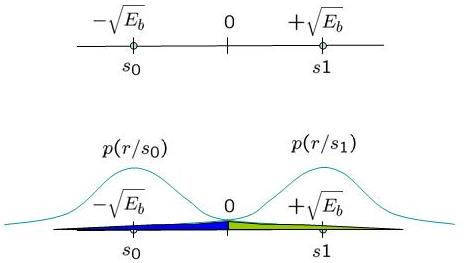
In this post, we will derive the theoretical equation for bit error rate (BER) with Binary Phase Shift Keying (BPSK) modulation scheme in Additive White Gaussian Noise (AWGN) channel. The BER results obtained using Matlab/Octave & Python simulation scripts show good agreement with the derived theoretical results.
System Model
Transmitter
With Binary Phase Shift Keying (BPSK), the binary digits 1 and 0 maybe represented by the analog levels and
respectively. The system model is as shown in the Figure below.