Hamming (7,4) code with soft and hard decoding

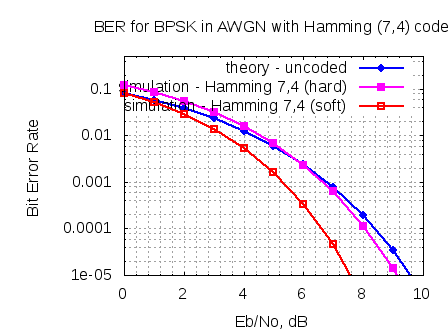
An earlier post we discussed hard decision decoding for a Hamming (7,4) code and simulated the the bit error rate. In this post, let us focus on the soft decision decoding for the Hamming (7,4) code, and quantify the bounds in the performance gain.

Continue reading “Hamming (7,4) code with soft and hard decoding”

ADC SNR with clock jitter and quantization noise

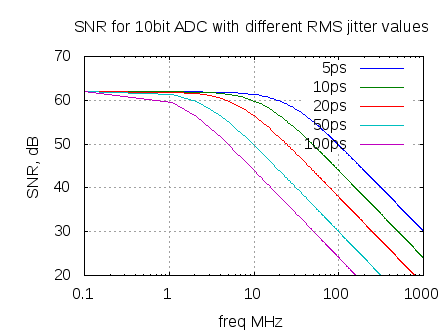
My friend and colleague Mr. Vineet Srivastava pointed me to a nice article on  clock jitter – Clock Jitter Effects on Sampling : A tutorial – by Carlos Azeredo-Leme, IEEE Circuits and Systems Magazine, Third Quarter 2011. In this post, let us discuss the total Signal to Noise Ratio at the output of an analog to digital converter (ADC) accounting for errors due to sampling clock jitter and quantization noise.

Continue reading “ADC SNR with clock jitter and quantization noise”

Weighted Least Squares and locally weighted linear regression

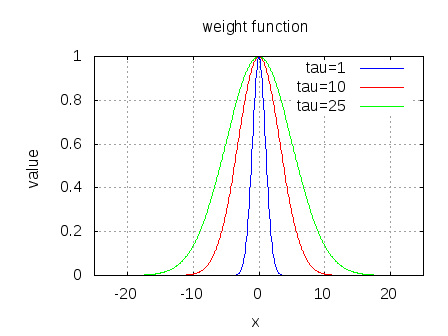
From the post on Closed Form Solution for Linear regression, we computed the parameter vector  which minimizes the square of the error between the predicted value  and the actual output  for all  values in the training set. In that model all the  values in the training set is given equal importance.  Let us consider the case where it is known some observations are important than the other. This post attempts to the discuss the case where some observations need to be given more weights than others (also known as weighted least squares).

Continue reading “Weighted Least Squares and locally weighted linear regression”

Least Squares in Gaussian Noise – Maximum Likelihood

From the previous posts on Linear Regression (using Batch Gradient descent, Stochastic Gradient Descent, Closed form solution), we discussed couple of different ways to estimate the  parameter vector in the least square error sense for the given training set. However, how does the least square error criterion work when the training set is corrupted by noise? In this post, let us discuss the case where training set is corrupted by Gaussian noise.

Continue reading “Least Squares in Gaussian Noise – Maximum Likelihood”

Symbol Error rate for QAM (16, 64, 256,.., M-QAM)

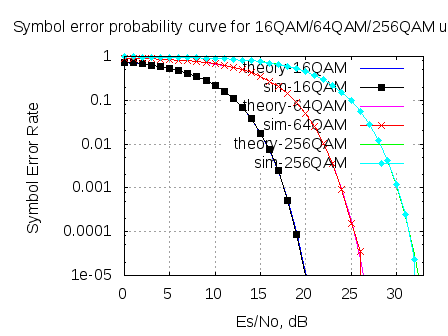
In May 2008, we derived the theoretical symbol error rate for a general M-QAM modulation (in  Embedded.comDSPDesignLine.com and dsplog.com) under Additive White Gaussian Noise. While re-reading that post, felt that the article is nice and warrants a re-run, using OFDM as the underlying physical layer. This post discuss the derivation of symbol error rate for a general M-QAM modulation. The companion Matlab script compares the theoretical and the simulated symbol error rate for 16QAM, 64QAM and 256QAM over OFDM in AWGN channel.

Enjoy and HAPPY NEW YEAR 2012 !!!

Continue reading “Symbol Error rate for QAM (16, 64, 256,.., M-QAM)”