2008
MIMO with ML equalization
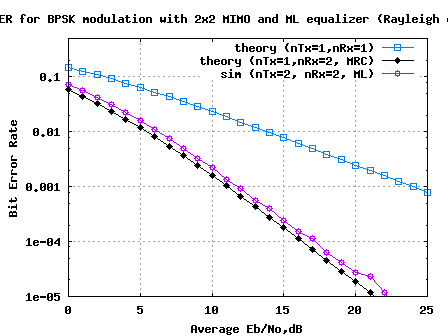
We have discussed quite a few receiver structures for a 2×2 MIMO channel namely, (a) Zero Forcing (ZF) equalization (b) Minimum Mean Square Error (MMSE) equalization (c) Zero Forcing equalization with Successive Interference Cancellation (ZF-SIC) (d) ZF-SIC with optimal ordering and (e) MIMO with MMSE SIC and optimal ordering From the above receiver structures, we…
Join dspLog at Google FriendConnect
We have installed Google FriendConnect on dspLog.com. With Google Friend Connect, you can: (a) You can interact with other members who have similiar interests. You will come to know the list of other sites (apart from dspLog.com) where the members have joined. You can add a member as a friend and so on. (b) You…
MIMO with MMSE SIC and optimal ordering
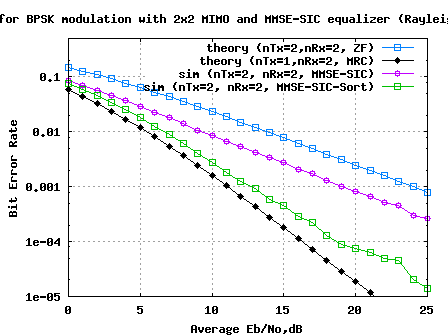
This post attempts to build further on the MIMO equalization schemes which we have discussed – (a) Minimum Mean Square Error (MMSE) equalization, (b) Zero Forcing equalization with Successive Interference Cancellation (ZF-SIC) and (c) ZF-SIC with optimal ordering. We have learned that successive interference cancellation with optimal ordering improves the performance with Zero Forcing equalization….
MIMO with ZF SIC and optimal ordering
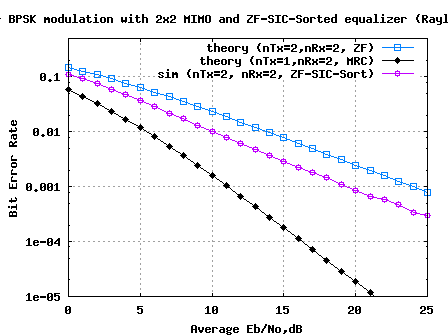
In previous posts, we had discussed equalization of a 2×2 MIMO channel with Zero Forcing (ZF) equalization and later, Zero Forcing equalization with successive interference cancellation (ZF-SIC). In this post, we will explore a variant of ZF-SIC called Zero Forcing Successive Interference Cancellation with optimal ordering. We will assume that the channel is a flat…
Linear to log conversion
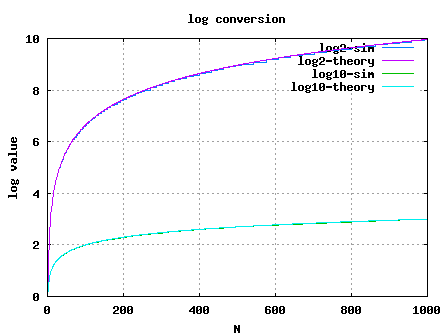
In signal processing blocks like power estimation used in digital communication, it may be required to represent the estimate in log scale. This post explains a simple linear to log conversion scheme proposed in the DSP Guru column on DSP Trick: Quick-and-Dirty Logarithms. The scheme makes implementation of a linear to log conversion simple and…
MIMO with Zero Forcing Successive Interference Cancellation equalizer
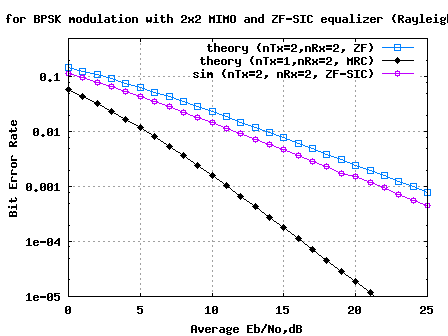
The post on MIMO with Zero Forcing equalizer discussed a probable way of equalizing a 2×2 MIMO channel. The simulated results with the 2×2 MIMO system with zero forcing equalizer showed matching results as obtained in for a 1×1 system for BPSK modulation in Rayleigh channel. In this post, we will try to improve the…
MIMO with MMSE equalizer
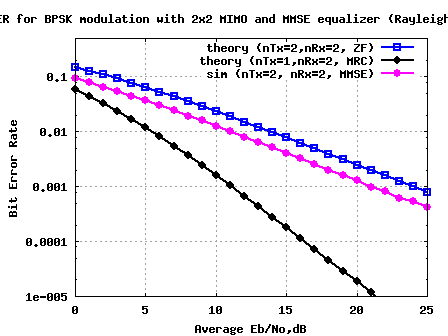
In a previous post, we had discussed a 2×2 MIMO transmission using BPSK modulation in Rayleigh channel with a Zero Forcing equalizer. The simulated results with the 2×2 MIMO system with zero forcing equalizer showed matching results as obtained in for a 1×1 system for BPSK modulation in Rayleigh channel. In this post, we will…
Happy Birthday – dspLog
An important milestone for the dspLog happened on Oct 21st 2008. On this day last year, the blog migrated from the Blogger platform to the independently hosted platform at www.dsplog.com ! Belated birthday wishes for the blog!!! 🙂 Looking back, the first year was satisfying – both in terms of contents and traffic. We started…
MIMO with Zero Forcing equalizer
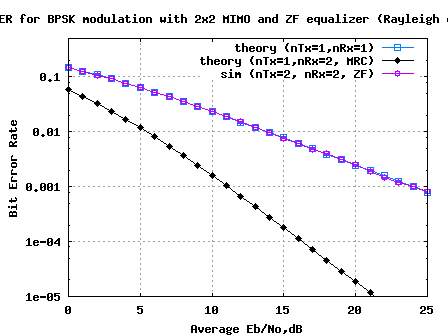
We had discussed three Single Input Multiple Output (SIMO also known as receive diversity) schemes – Selection combining, Equal Gain Combining, Maximal Ratio Combining and a Multiple Input Single Output (MISO, also known as transmit diversity) scheme – Alamouti 2×1 STBC. Let us now discuss the case where there a multiple transmit antennas and multiple…
Alamouti STBC
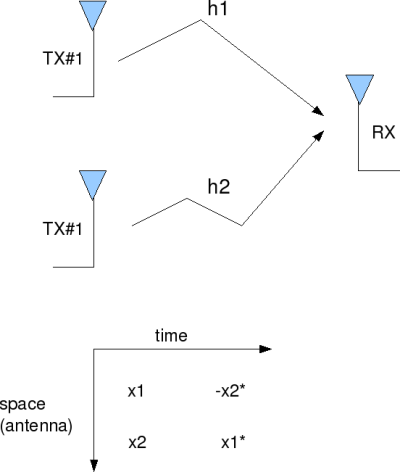
In the recent past, we have discussed three receive diversity schemes – Selection combining, Equal Gain Combining and Maximal Ratio Combining. All the three approaches used the antenna array at the receiver to improve the demodulation performance, albeit with different levels of complexity. Time to move on to a transmit diversity scheme where the information…
Download free e-book on error probability in AWGN
We have quite a few articles discussing bit and symbol error rates for popular digital modulation schemes in Additive White Gaussian Noise (AWGN) channel. This post summarizes the articles discussing the theoretical and simulated error rates for the digital modulation schemes like BPSK, QPSK, 4–PAM, 16PSK and 16QAM. Further, Bit Error Rate with Gray coded…
Maximal Ratio Combining (MRC)
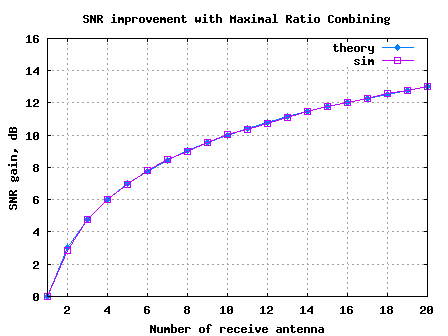
This is the third post in the series discussing receiver diversity in a wireless link. Receiver diversity is a form of space diversity, where there are multiple antennas at the receiver. The presence of receiver diversity poses an interesting problem – how do we use ‘effectively‘ the information from all the antennas to demodulate the…
Equal Gain Combining (EGC)
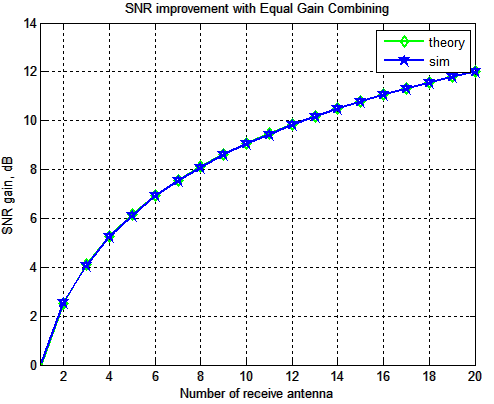
This is the second post in the series discussing receiver diversity in a wireless link. Receiver diversity is a form of space diversity, where there are multiple antennas at the receiver. The presence of receiver diversity poses an interesting problem – how do we use ‘effectively‘ the information from all the antennas to demodulate the…