Happy Birthday – dspLog

An important milestone for the dspLog happened on Oct 21st 2008. On this day last year, the blog migrated from the Blogger platform to the independently hosted platform at www.dsplog.com ! Belated birthday wishes for the blog!!! 🙂

Looking back, the first year was satisfying – both in terms of contents and traffic. We started off by discussing symbol error rates for various modulation schemes in AWGN. slowed moved tobit error rates, then to OFDM, multipath channel and recently towards multi-antenna schemes. The traffic slowly gorwed and now we have around 300+ subscribers. Continue reading “Happy Birthday – dspLog”
MIMO with Zero Forcing equalizer

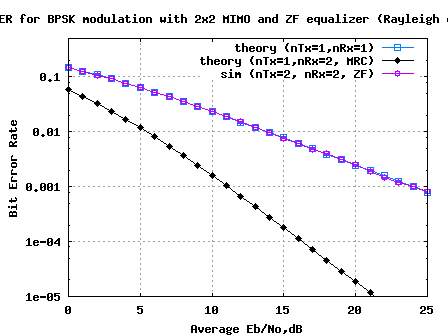
We had discussed three Single Input Multiple Output (SIMO also known as receive diversity) schemes – Selection combining, Equal Gain Combining, Maximal Ratio Combining and a Multiple Input Single Output (MISO, also known as transmit diversity) scheme – Alamouti 2×1 STBC. Let us now discuss the case where there a multiple transmit antennas and multiple receive antennas resulting in the formation of a Multiple Input Multiple Output (MIMO) channel. In this post, we will restrict our discussion to a 2 transmit 2 receive antenna case (resulting in a 2×2 MIMO channel). We will assume that the channel is a flat fading Rayleigh multipath channel and the modulation is BPSK.

Continue reading “MIMO with Zero Forcing equalizer”

Alamouti STBC

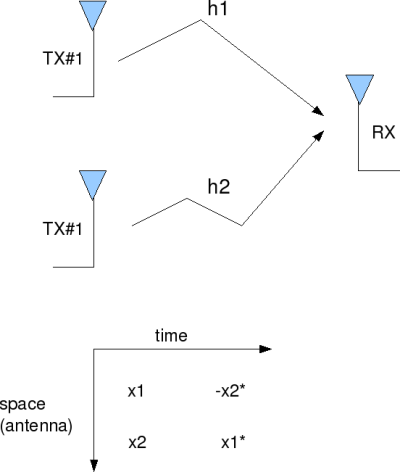
In the recent past, we have discussed three receive diversity schemes – Selection combining, Equal Gain Combining and Maximal Ratio Combining. All the three approaches used the antenna array at the receiver to improve the demodulation performance, albeit with different levels of complexity. Time to move on to a transmit diversity scheme where the information is spread across multiple antennas at the transmitter. In this post, lets discuss a popular transmit diversity scheme called Alamouti Space Time Block Coding (STBC). For the discussion, we will assume that the channel is a flat fading Rayleigh multipath channel and the modulation is BPSK.

Continue reading “Alamouti STBC”

Download free e-book on error probability in AWGN

We have quite a few articles discussing bit and symbol error rates for popular digital modulation schemes in Additive White Gaussian Noise (AWGN) channel. This post summarizes the articles discussing the theoretical and simulated error rates for the digital modulation schemes like BPSK, QPSK, 4PAM, 16PSK and 16QAM. Further, Bit Error Rate with Gray coded mapping, bit error rate for BPSK over OFDM are also discussed.

The links to the individual articles and the Matlab/Octave simulation models are listed below. Alternatively, I have made a e-book discussing all the below mentioned articles to a single PDF file. If you wish, you can download the free e-book by subscribing to the free email newsletter.

Subscribe and download the free e-Book

Continue reading “Download free e-book on error probability in AWGN”