Are you bothered by speed of the speed of the simulations which you develop in Matlab/Octave? I was not bothered much, till I ran into the Viterbi decoder. If you recall, the Matlab/Octave simulation script for BER computation with hard soft decision Viterbi algorithm provided in post Viterbi with finite survivor state memory took around 10 hours to run.
Tag: Viterbi
Viterbi with finite survivor state memory
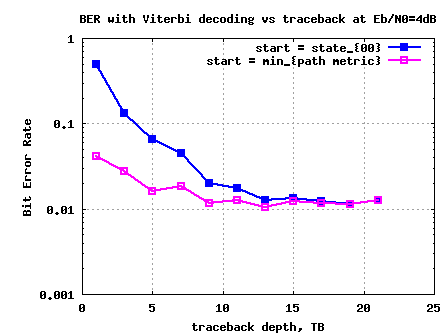
In the post on Viterbi decoder and soft input Viterbi decoder, we discussed a convolutional encoding scheme with rate 1/2, constraint length and having generator polynomial
and having generator polynomial
. If the number of uncoded bits is
, then the number of coded bits at the output of the convolutional encoder is
. Decoding the convolutionaly encoded bits by Viterbi algorithm consisted of the following steps.
Continue reading “Viterbi with finite survivor state memory”
Softbit for 16QAM
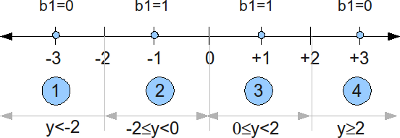
In the post on Soft Input Viterbi decoder, we had discussed BPSK modulation with convolutional coding and soft input Viterbi decoding in AWGN channel. Let us know discuss the derivation of soft bits for 16QAM modulation scheme with Gray coded bit mapping. The channel is assumed to be AWGN alone.
Soft Input Viterbi decoder
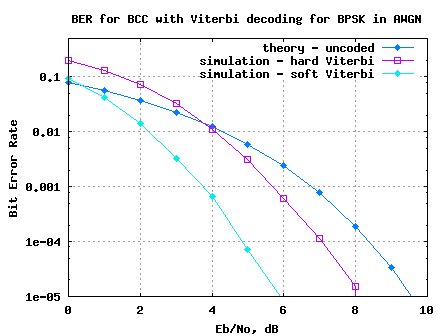
In two previous posts, we have discussed Convolutional Coding and the associated hard decision Viterbi decoding. In this post lets extent Viterbi decoding algorithm to soft input decision scheme. The modulation used is BPSK and the channel is assumed to be AWGN alone.
Viterbi decoder
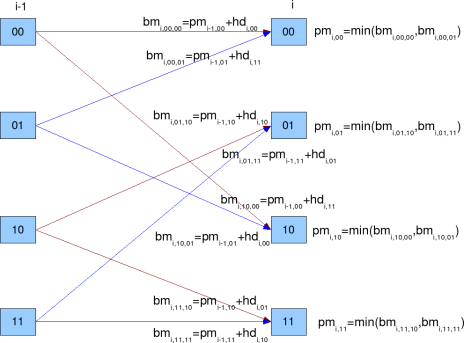
Coding is a technique where redundancy is added to original bit sequence to increase the reliability of the communication. Lets discuss a simple binary convolutional coding scheme at the transmitter and the associated Viterbi (maximum likelihood) decoding scheme at the receiver.
Update: For some reason, the blog is unable to display the article which discuss both Convolutional coding and Viterbi decoding. As a work around, the article was broken upto into two posts.
This post descrbes the Viterbi decoding algorithm for a simple Binary Convolutional Code with rate 1/2, constraint length and having generator polynomial
. For more details on the Binary convolutional code, please refer to the post – Convolutional code