Comparing 16PSK vs 16QAM for symbol error rate

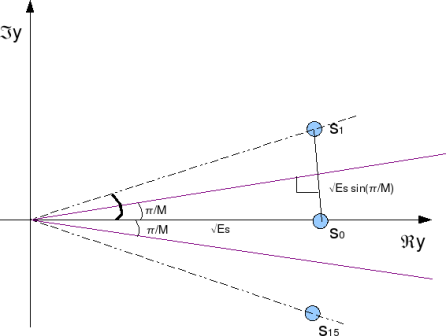
In two previous posts, we have derived theoretical symbol error rate for 16-QAM and 16-PSK modulation schemes. The links are:

(a) Symbol error rate for 16-PSK

(b) Symbol error rate for 16-QAM

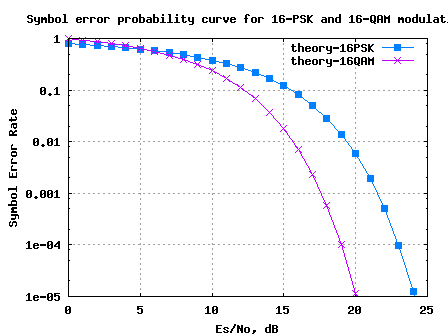
Given that we are transmitting the same number of constellation points in both 16-PSK and 16-QAM, let us try to understand the better modulation scheme among the two, i.e. to answer the following question:

For the same signal to noise ratio , will 16-PSK or 16-QAM give a lower symbol error rate?

Continue reading “Comparing 16PSK vs 16QAM for symbol error rate”
Frequency offset estimation using 802.11a short preamble

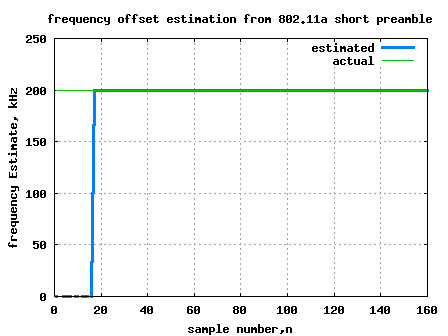
From the previous post on OFDM (here), we have understood that an OFDM waveform is made of sum of multiple sinusoidals (also called subcarriers) each modulated independently. In this post, let us try to understand the estimation of frequency offset in a typical OFDM receiver (using the short preamble specified per IEEE 802.11a specification as a reference).

Understanding frequency offset

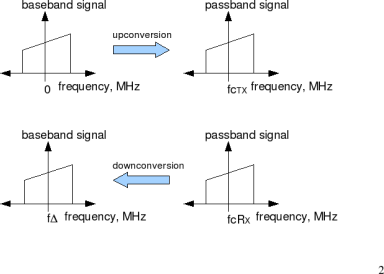
In a typical wireless communication system, the signal to be transmitted is upconverted to a carrier frequency prior to transmission. The receiver is expected to tune to the same carrier frequency for downconverting the signal to baseband, prior to demodulation.

Signal Up/Down conversion

Figure: Up/down conversion

Continue reading “Frequency offset estimation using 802.11a short preamble”