GATE-2012 ECE Q26 (electronic devices)

Question 26 on Electronic Devices from GATE (Graduate Aptitude Test in Engineering) 2012 Electronics and Communication Engineering paper.

Q26. The source of a silicon (), n-channel MOS transistor has an area of and a depth of  . If the dopant density in the source is , the number of holes in the source region with above volume is approximately

(A)

(B)

(C)

(D)

Solution

To answer this question, had to dig up the copy of Solid State Electronic Devices, Ben G Streetman, Sanjay Kumar Banarjee (buy from Amazon.com, buy from Flipkart.com) and am referring to the content from Section 3.3 Carrier Concentrations.

Electrons in solids obey Fermi-Dirac statistics.  The function  Fermi-Dirac distribution function, gives the probability that an available energy state at will be occupied by an electron at absolute temperature ,

.

The quantity  is the Fermi level and  is the Boltzmann’s constant.

The concentration of electrons in the conduction band is,

, where  is the density of states in the energy range .

The integral is equivalently stated as,

 alt=,  where  alt= is the effective density of states at conduction band edge  alt=.

The Fermi function at  alt= is approximately,

.

So in this condition the concentration of electrons in the conduction band is,

 alt=.

Similarly, the concentration of holes in the valence band is,

 alt=, where  alt= is the effective density of states at valence band edge  alt=.

The term,

.

So in this condition the concentration of holes in the valence band is,

 alt=.

The product of  alt= and  alt= at equilibrium is a constant for a particular material and temperature even if doping is varied.

 alt=where

 alt= is the gap between the conduction band and valence band.

Similarly, for an intrinsic material, the product of   alt= and  alt=  is, 

 alt=

For an intrinsic material, the electron and hole concentration are equal i.e.  alt=.

The constant product of electron and hole concentration can be written as

 alt=


With the above understanding, let us try to find the solution to the problem. In our question,

 alt= and  alt=.

The hole concentration is,
 alt=.

The volume of the source region is

 alt=.

The number of holes is,

 alt=


Based on the above, the right choice is (D) 0. 

References

[1] GATE Examination Question Papers [Previous Years] from Indian Institute of Technology, Madras http://gate.iitm.ac.in/gateqps/2012/ec.pdf

[2] Solid State Electronic Devices, Ben G Streetman, Sanjay Kumar Banarjee (buy from Amazon.combuy from Flipkart.com)

[3] Valence band http://en.wikipedia.org/wiki/Valence_band

[4] Conduction band http://en.wikipedia.org/wiki/Conduction_band
 

GATE-2012 ECE Q36 (math)

Question 36 on math from GATE (Graduate Aptitude Test in Engineering) 2012 Electronics and Communication Engineering paper.

Q36. A fair coin is tossed till a head appears for the first time. The probability that the number of required tosses is odd, is

(A) 1/3

(B) 1/2

(C) 2/3

(D) 3/4

Solution

Let us start by finding the sample space. The possible sample space with odd number of tosses till a head appears for the first time is,

Given that the coin is fair,

.

The total probability is,

Using Taylor series,

.

Substituting,

Matlab/Octave example

Felt it would be nice to get similar results using a simple simulation model

% Script to find the probability that odd number of tosses
% are required to get a head for the first time

clear all; close all;
N = 5*10^5;

% HEAD = 0, TAIL = 1;
% definfing the pattern corresponding to odd tosses 
% till the first head - limiting to max of 21 tosses
% converted to integer (for easy comparison)
pattern_v = [ ...
   sum(2.^0         .*  [0 ]);                      ... % H
   sum(2.^(2:-1:0)  .*  [1 1 0 ]);                  ... % TTH
   sum(2.^(4:-1:0)  .*  [1 1 1 1 0 ]);              ... % TTTTH 
   sum(2.^(6:-1:0)  .*  [1 1 1 1 1 1 0 ]);          ... % TTTTTTH 
   sum(2.^(8:-1:0)  .*  [1 1 1 1 1 1 1 1 0 ]);      ... % TTTTTTTTH ...
   sum(2.^(10:-1:0) .*  [1 1 1 1 1 1 1 1 1 1 0 ]);  ...  
   sum(2.^(12:-1:0) .*  [1 1 1 1 1 1 1 1 1 1 1 1 0 ]); ...
   sum(2.^(14:-1:0) .*  [1 1 1 1 1 1 1 1 1 1 1 1 1 1 0 ]); ... 
   sum(2.^(16:-1:0) .*  [1 1 1 1 1 1 1 1 1 1 1 1 1 1 1 1 0 ]); ... 
   sum(2.^(18:-1:0) .*  [1 1 1 1 1 1 1 1 1 1 1 1 1 1 1 1 1 1 0 ]); ...
   sum(2.^(20:-1:0) .*  [1 1 1 1 1 1 1 1 1 1 1 1 1 1 1 1 1 1 1 1 0 ]); ...
  ];

% finding the probability for each event in the  sample space
event_v = [1:2:21];
for ii=1:length(event_v)
   kk           = event_v(ii);
   x            = rand(N,kk)>0.5;
   xVal         = sum((ones(N,1)*[2.^([kk-1:-1:0])]).*x,2);
   matchCnt(ii) = size(find(xVal==pattern_v(ii)),1);
end
totalProb = sum(matchCnt./N)

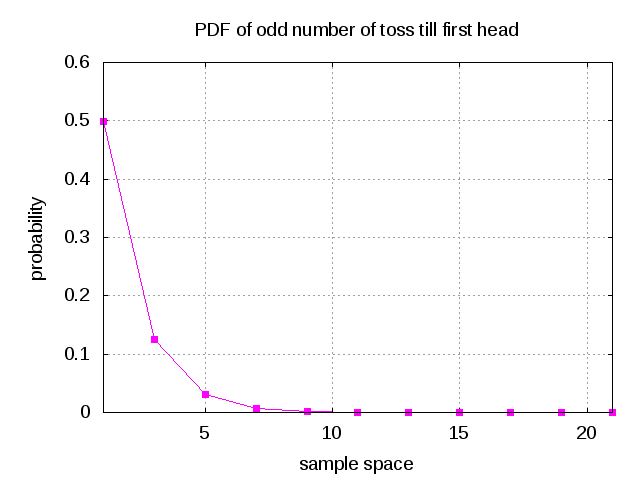
Figure : Probability of odd number of tosses till first head

Based on the above, the right choice is (C) 2/3. 

References

[1] GATE Examination Question Papers [Previous Years] from Indian Institute of Technology, Madras http://gate.iitm.ac.in/gateqps/2012/ec.pdf

[2] Wiki entry on Taylor series http://en.wikipedia.org/wiki/Taylor_series


GATE-2012 ECE Q46 (math)

Question 46 on math from GATE (Graduate Aptitude Test in Engineering) 2012 Electronics and Communication Engineering paper.

Q46. The maximum value of  in the interval [1, 6] is

(A) 21

(B) 25

(C) 41

(D) 46

Solution

Let us start by finding the critical points of the function .

The first derivative is,

.

Solving by setting .

.

Taking second derivative, .

At and this corresponds to a local minimum.

At and this corresponds to a local maximum.

The value of the function at these critical points are,

.

Hold on, we are not done yet… 🙂


From the wiki entry on Extereme Value Theorem

In calculus, the extreme value theorem states that if a real-valued function f is continuous in the closed and bounded interval [a,b], then f must attain its maximum and minimum value, each at least once. That is, there exist numbers c and d in [a,b] such that:

.

Further, from wiki entry on finding maxima and minima,

If a function is continuous on a closed interval, then by the extreme value theorem global maxima and minima exist. Furthermore, a global maximum (or minimum) either must be a local maximum (or minimum) in the interior of the domain, or must lie on the boundary of the domain. So a method of finding a global maximum (or minimum) is to look at all the local maxima (or minima) in the interior, and also look at the maxima (or minima) of the points on the boundary; and take the biggest (or smallest) one.

For our example, the function is real valued and is continuous in the closed and bounded interval [1,6].

Finding out the value of the function at the boundaries,

.

So the global maximum of the function  in the interval [1, 6] is  and it occurs at the boundary i.e. x = 6.

Matlab example

clear all; close all;
x = [1:.1:6];
fx = x.^3 - 9*x.^2 + 24*x + 5;
plot(x,fx);
xlabel('x'); ylabel('fx');
grid on; axis([1 6 20 45]);
title('fx  =  x^3 - 9x^2 + 24x + 5');

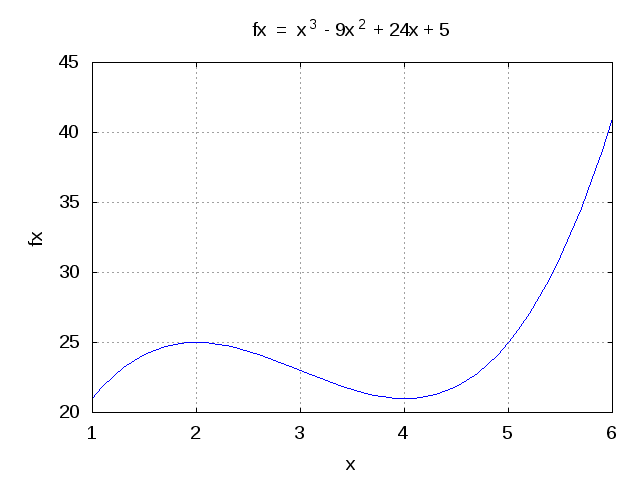
Figure : Plot of the function  in the interval [1,6]

From the figure, it is relatively easy to observe that the maximum is hit at x=6 (and not at the local maximum point of x=2).


Based on the above, the right choice is (C) 41. 

References

[1] GATE Examination Question Papers [Previous Years] from Indian Institute of Technology, Madras http://gate.iitm.ac.in/gateqps/2012/ec.pdf

[2] Wiki entry on Extreme Value Theorem

http://en.wikipedia.org/wiki/Extreme_value_theorem

[3] Wiki entry on Maxima and Minima

http://en.wikipedia.org/wiki/Maxima_and_minima

GATE-2012 ECE Q24 (math)

Question 24 on math from GATE (Graduate Aptitude Test in Engineering) 2012 Electronics and Communication Engineering paper.

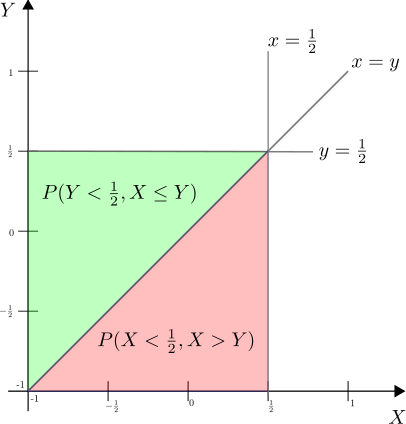
Q24. Two independent random variables X and Y are uniformly distributed in the interval [-1, 1]. The probability that max[X,Y] is less than 1/2 is

(A) 3/4

(B) 9/16

(C) 1/4

(D) 2/3

Continue reading “GATE-2012 ECE Q24 (math)”

GATE-2012 ECE Q6 (digital)

Question 6 on digital circuit from GATE (Graduate Aptitude Test in Engineering) 2012 Electronics and Communication Engineering paper.

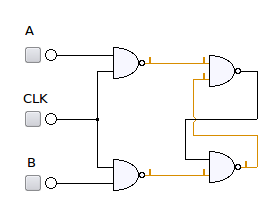
Q6. Consider the given circuit

In this circuit, the race around

(A) does not occur

(B) occurs when CLK=0

(C) occurs when CLK=1 and A=B=1

(D) occurs when CLK=1 and A=B=0

Continue reading “GATE-2012 ECE Q6 (digital)”