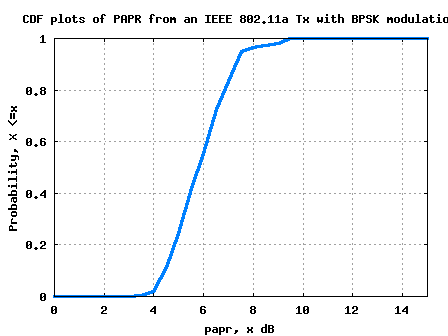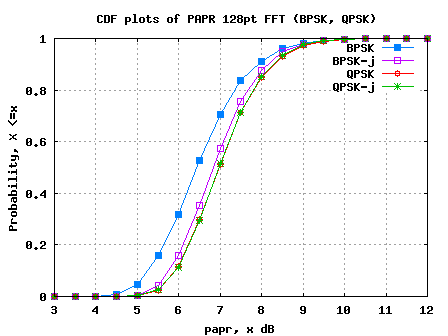
In this post, we will explore a probable way of reducing PAPR (peak to average power ratio) in OFDM by changing the phase of some of the subcarriers. This is in response to the comment to post on Peak to Average power ratio for OFDM, where Mr. Elibom suggested to reduce the PAPR by cyclically rotate some of the subcarriers and using.
Further, the presentation in the IEEE TGN, PAPR in HT-LTF (11-06/1595r1), mentions that in 40MHz mode where a 128pt FFT is used, PAPR of HT-LTF (High Throughput Long Training Field) can be reduced by multiplying the upper 20MHz subcarriers by j. Using quick Matlab simulations, we will try to validate that claim for HT-LTF and further check the PAPR for a general random BPSK and QPSK modulation.
Continue reading “Trying out PAPR reduction for OFDM by multiplication with j”