Derivation of BPSK BER in Rayleigh channel

This is a guest post by Jose Antonio Urigüen who is an Electrical and Electronic Engineer currently studying an MSc in Communications and Signal Processing at Imperial College in London. This guest post has been created due to his own curiosity when reviewing some concepts of BER for BPSK in Rayleigh channnel published in the dsplog.com

From the post on BER for BPSK in Rayleigh channnel, it was shown that, in the presence of channel , the effective bit energy to noise ratio is .

Continue reading “Derivation of BPSK BER in Rayleigh channel”
Viterbi decoder

Coding is a technique where redundancy is added to original bit sequence to increase the reliability of the communication. Lets discuss a simple binary convolutional coding scheme at the transmitter and the associated Viterbi (maximum likelihood) decoding scheme at the receiver.

Update: For some reason, the blog is unable to display the article which discuss both Convolutional coding and Viterbi decoding. As a work around, the article was broken upto into two posts.

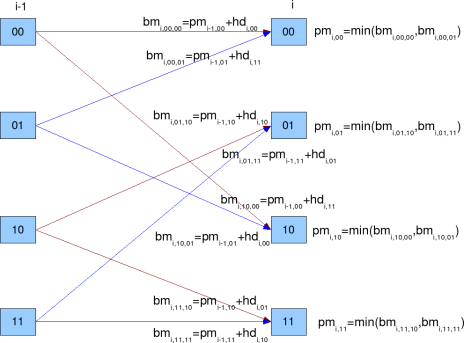
This post descrbes the Viterbi decoding algorithm for a simple Binary Convolutional Code with rate 1/2, constraint length and having generator polynomial . For more details on the Binary convolutional code, please refer to the post – Convolutional code

Continue reading “Viterbi decoder”

Convolutional code

Coding is a technique where redundancy is added to original bit sequence to increase the reliability of the communication. In this article, lets discuss a simple binary convolutional coding scheme at the transmitter and the associated Viterbi (maximum likelihood) decoding scheme at the receiver.

Update: For some reason, the blog is unable to display the article which discuss both Convolutional coding and Viterbi decoding. As a work around, the article was broken upto into two posts. This post descrbes a simple Binary Convolutional Coding scheme. For details on the Viterbi decoding algorithm, please refer to the post – Viterbi decoder.

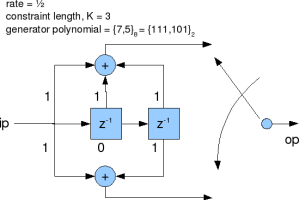
Chapter 8, Table 8.2-1 of Digital Communications by John Proakis lists the various rate 1/2 convolutional coding schemes. The simplest among them has constraint length with generator polynomial . There are three parameters which define the convolotional code:

Continue reading “Convolutional code”