Bounds on Communication based on Shannon’s capacity

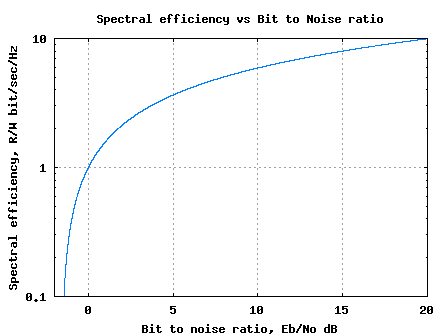
This is the second post in the series aimed at developing a better understanding of Shannon’s capacity equation. In this post let us discuss the bounds on communication given the signal power and bandwidth constraint. Further, the following writeup is based on Section 12.6 from Fundamentals of Communication Systems by John G. Proakis, Masoud Salehi

Continue reading “Bounds on Communication based on Shannon’s capacity”
Understanding Shannon’s capacity equation

Let us try to understand the formula for Channel Capacity with an Average Power Limitation, described in Section 25 of the landmark paper A Mathematical Theory for Communication, by Mr. Claude Shannon.

Further, the following writeup is based on Section 12.5.1 from Fundamentals of Communication Systems by John G. Proakis, Masoud Salehi

Continue reading “Understanding Shannon’s capacity equation”

BPSK BER with OFDM modulation

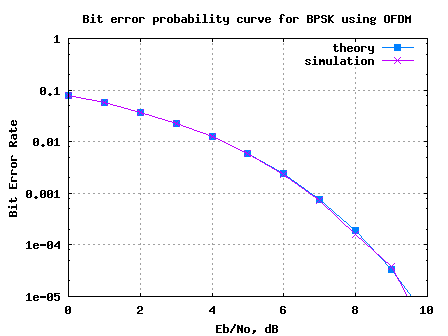
Oflate, I am getting frequent requests for bit error rate simulations using OFDM (Orthogonal Frequency Division Multiplexing) modulation. In this post, we will discuss a simple OFDM transmitter and receiver, find the relation between Eb/No (Bit to Noise ratio) and Es/No (Signal to Noise ratio) and compute the bit error rate with BPSK.

Continue reading “BPSK BER with OFDM modulation”

16QAM Bit Error Rate (BER) with Gray mapping

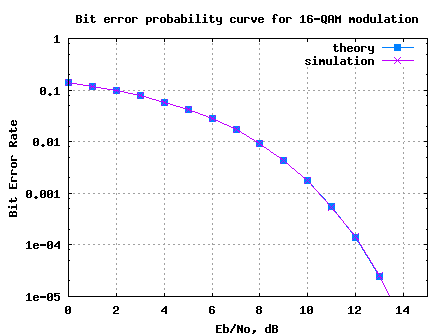
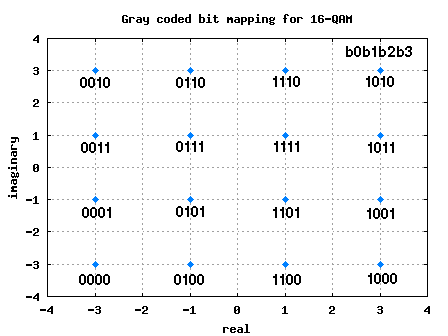
Let us derive the theoretical 16QAM bit error rate (BER) with Gray coded constellation mapping in additive white Gaussian noise conditions. Further, the Matlab/Octave simulation script can be used to confirm that the simulation is in good agreement with theory.

Continue reading “16QAM Bit Error Rate (BER) with Gray mapping”

Binary to Gray code for 16QAM

In the previous post on Binary to Gray code conversion for PSK, I had claimed that “for a general M-QAM modulation the binary to Gray code conversion is bit more complicated“. However following a closer look, I realize that this is not so complicated. 🙂

The QAM scenario can be treated as independent PAM modulation on I arm and Q-arm respectively. For example, let us consider 16-QAM scenario.

Continue reading “Binary to Gray code for 16QAM”