
The earlier posts on phase noise discussed about phase noise in oscillators, conversion of phase noise profile to jitter and the impact of phase noise on the error vector magnitude (evm). This post discuss the impact of phase noise on the spectrum of the transmit waveform. A simple random QPSK modulated symbols, oversampled and passed through a root raised cosine filtering is used for the simulation. Continue reading “Transmit spectrum with phase noise”
Tag: phase
EVM with phase noise
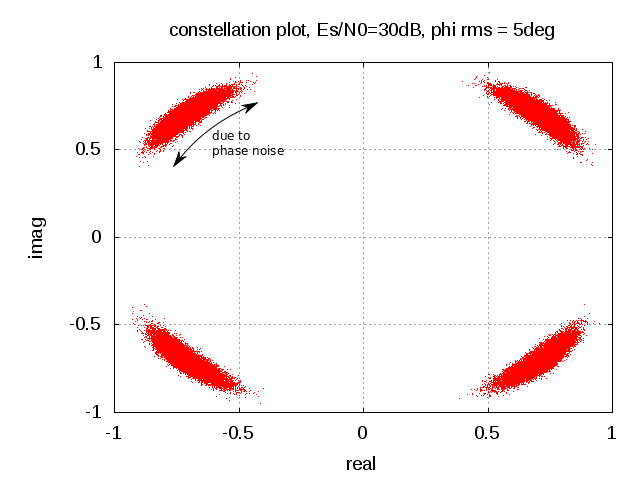
The previous post on phase noise discussed about finding the root mean square phase noise for a given phase noise profile. In this post let us discuss about the impact of phase noise on the error vector magnitude (evm) of a transmit symbol.
Phase noise power spectral density to Jitter
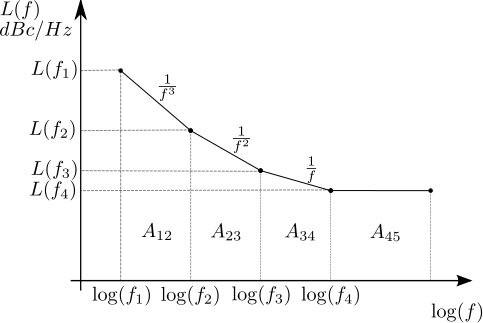
Following a brief discussion with my friend Mr. Rethnakaran Pulikkoonattu on phase noise profiles, he pointed me to his write up on Oscillator Phase Noise and Sampling Clock Jitter . In this post, we will discuss the math behind integrating the phase noise power spectral density (in dBc/Hz) to find the root mean square jitter value.
Continue reading “Phase noise power spectral density to Jitter”
Oscillator phase noise
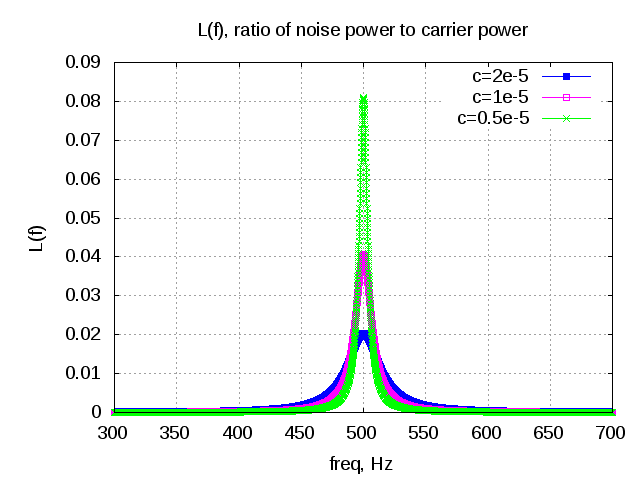
Oscillators are used in typical radio circuits to drive the mixer used for the up-conversion or down-conversion of the passband transmission. Ideally, the spectrum of the oscillator is expected to have an impulse at the frequency of oscillation with no frequency components else where. However the spectrum of practical oscillators do have spectrum skirts around the oscillation frequency caused due to phase noise. This post discuss about the phase noise of oscillator and the metrics used to specify it.
Using CORDIC for phase and magnitude computation
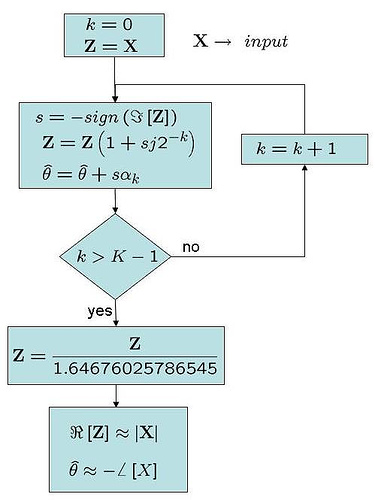
In a previous post (here), we looked at using CORDIC (Co-ordinate Rotation by DIgital Computer) for understanding how a complex number can be rotated by an angle
without using actual multipliers. Let us know try to understand how we can use CORDIC for finding the phase and magnitude of a complex number.
Basics
The CORDIC algorithm is built on successively multiplying the complex number , by
. As can be noticed, as the elements of
can be represented in powers of 2, the multiplication can be achieved by using the appropriate ‘bit shift’. For further details, please refer to the previous post (CORDIC for phase rotation).
Continue reading “Using CORDIC for phase and magnitude computation”
CORDIC for phase rotation
My understanding of the CORDIC (Co-ordinate Rotation by DIgital Computer) thanks to the nice article in [DSPGURU-CORDIC].
First order digital PLL for tracking constant phase offset
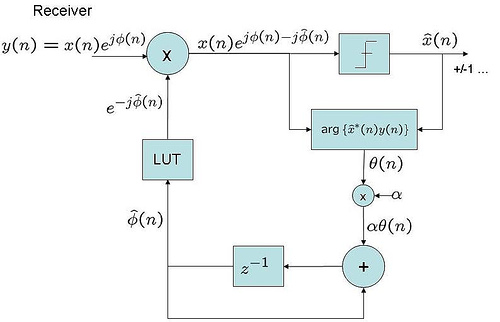
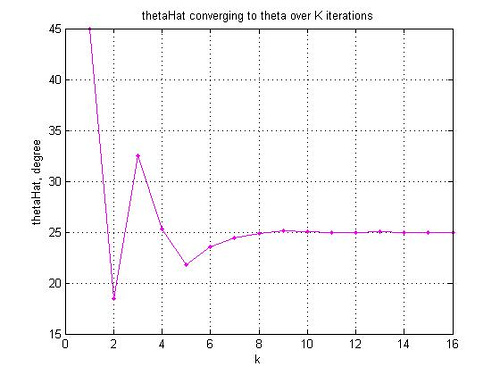
Considering a typical scenario where there might exist a small phase offset between local oscillator between the transmitter and receiver.
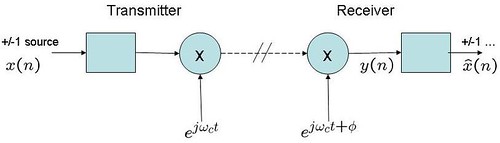
Figure 1 : Transmitter receiver with constant phase offset
In such cases, it might be desirable to estimate and track the phase offset such that the performance of the receiver does not degrade.
Continue reading “First order digital PLL for tracking constant phase offset”