Quiz on IEEE 802.11a specifications

The IEEE 802.11a specifications are used by many to understand a wireless communication link built using OFDM. In this post, I have put together a set of 10 multiple choice questions based on 802.11a specifications. The questions are on the building blocks in 802.11a specifications, preamble structure and so on. Upon completion of the quiz, you will be lead to a page showing the correct answers and their explanations.

Click here to download IEEE 802.11a specifications.

Note: The quiz might not be visible on RSS reader or over email. Please visit the site to access the quiz.

Good luck!

[QUIZZIN 4]
Frequency offset estimation using 802.11a short preamble

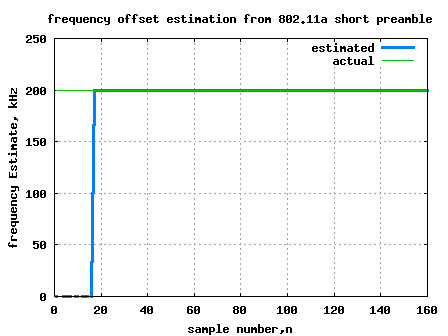
From the previous post on OFDM (here), we have understood that an OFDM waveform is made of sum of multiple sinusoidals (also called subcarriers) each modulated independently. In this post, let us try to understand the estimation of frequency offset in a typical OFDM receiver (using the short preamble specified per IEEE 802.11a specification as a reference).

Understanding frequency offset

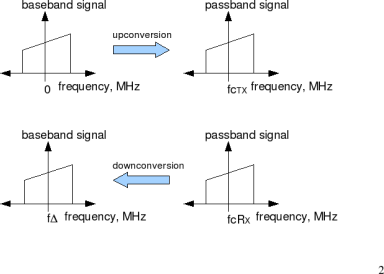
In a typical wireless communication system, the signal to be transmitted is upconverted to a carrier frequency prior to transmission. The receiver is expected to tune to the same carrier frequency for downconverting the signal to baseband, prior to demodulation.

Signal Up/Down conversion

Figure: Up/down conversion

Continue reading “Frequency offset estimation using 802.11a short preamble”

Peak to Average Power Ratio for OFDM

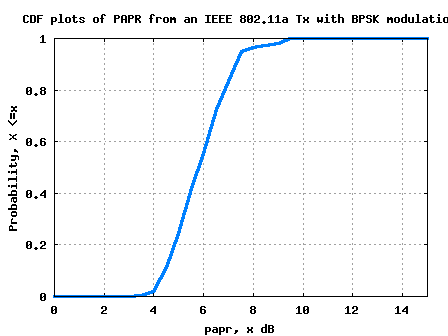
Let us try to understand peak to average power ratio (PAPR) and its typical value in an OFDM system specified per IEEE 802.11a specifications.

What is PAPR?

The peak to average power ratio for a signal is defined as
, where
corresponds to the conjugate operator.

Expressing in deciBels,
.

Continue reading “Peak to Average Power Ratio for OFDM”

Cylcic prefix in Orthogonal Frequency Division Multiplexing

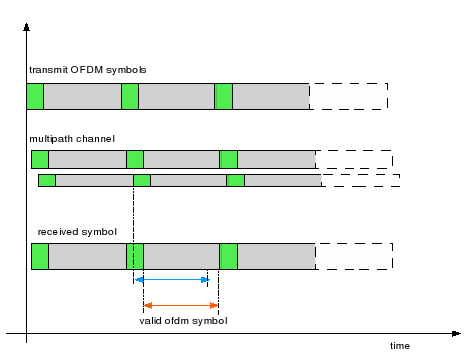
In a previous post (here), we discussed in brief, Orthogonal Frequency Division Multiplexing (OFDM) transmission. Let us know probe bit more into the motivation of cyclic prefix (aka guard interval) associated with each OFDM symbol.

What is cyclic prefix?
Let us consider one subcarrier (subcarrier +1 specified in IEEE 802.11a specification) alone. In the figure shown below, the blue line corresponds to the original sinusoidal where one cycle of the sinusoidal is of duration 64 samples ( with 20MHz sampling), corresponding to subcarrier of frequency 312.5kHz.

Continue reading “Cylcic prefix in Orthogonal Frequency Division Multiplexing”