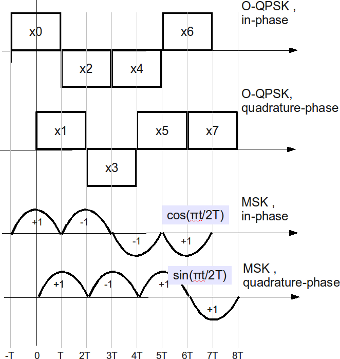
In a post on Minimum Shift Keying (MSK), we had discussed that MSK uses two frequencies which are separated by and phase discontinuity is avoided in symbol boundaries. In that post, we had discussed MSK as a continuous phase transmit signal and showed that phase changes through 0, 90, 180 and 270 degrees. In this post, we will discuss MSK transmission as a variant of offset-QPSK technique. Further, we will discuss the receiver structure and show that bit error rate with coherent demodulation of MSK (using
time) is equivalent to that of BPSK modulation. The channel assumed is AWGN.
Tag: FSK
Simulating Minimum Shift Keying Transmitter
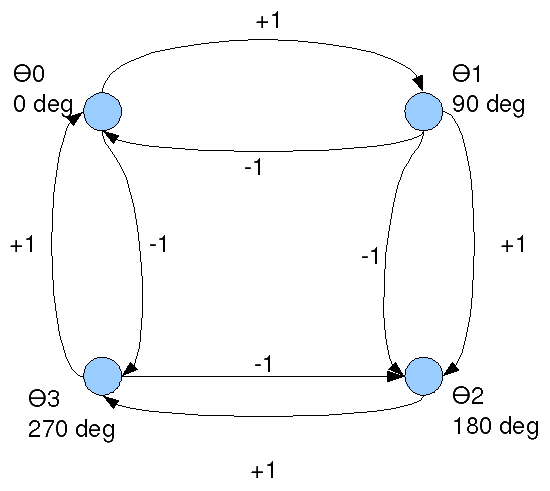
Minimum shift keying (MSK) is an important concept to learn in digital communications. It is a form of continuous phase frequency shift keying . In minimum phase shift keying, two key concepts are used.
(a) The frequency separation of the sinusoidals used for representing bits 1’s and 0’s are , where
is the symbol period.
(b) It is ensured that the resulting waveform is phase continuous.
Motivation of continuous phase
In a previous post (here), we have understood that the minimum frequency separation for two sinusoidals having zero phase difference to be orthogonal is , where
is the symbol period. However, it can be observed that at each symbol boundary, there is a phase discontinuity. The presence of phase discontinuities can result in large spectral side lobes outside the desired bandwidth. Hence the need for having a frequency modulated signal which is phase continuous.
Continue reading “Simulating Minimum Shift Keying Transmitter”
Bit Error Rate (BER) for frequency shift keying with coherent demodulation
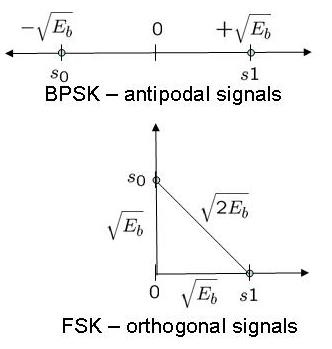
Following the request by Siti Naimah, this post discuss the bit error probability for coherent demodulation of binary Frequency Shift Keying (BFSK) along with a small Matlab code snippet.
Using the definition provided in Sec 4.4.4 of [DIG-COMM-SKLAR]
and
having frequencies
and
respectively, i.e.
,
where
is the energy ,
is the symbol duration and
is an arbitrary phase (assume to be zero).
Continue reading “Bit Error Rate (BER) for frequency shift keying with coherent demodulation”